


Political scientist: The problem in Albania is corrupt officials who refuse to face justice
Political scientist Afrim Krasniqi said today that the mai...

Political scientist Afrim Krasniqi said today that the mai...

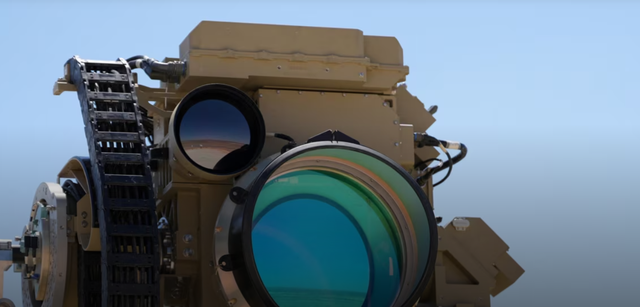
Disturbing amateur footage showing missiles seemingly disappearing in the sparks of explosions over Lebanon was shared online on March 2, along with claims that the videos showed the aftermath of an Israeli air defense weapon being fired, at a time when the conflict in the Middle East continues.
These claims have been widely disputed, but one element of the discussion is based on reality: since December 2025, the Israeli military has deployed a laser weapon, called the Iron Beam, built to combat the "various aerial threats" facing Israel.
In Ukraine, where near-daily Russian barrages of cheap, Iranian-made suicide drones have upended air defense strategies, several laser weapons are being developed. Ukrainian manufacturers claim they can overcome the increasingly unsustainable cost of defensive missiles used to counter cheap suicide drones.
"The cost calculation [of air defense] is now punishing ," Jared Keller, a U.S. laser weapons expert who publishes a newsletter on this still-developing technology, told REL.
"You can't use a million-dollar missile against a drone that costs $500. That just doesn't make any logical sense," he said.
There have been several attempts to develop laser weapons since the US became the first country to shoot down a drone with a laser in 1973, but the technology had remained experimental until recently.
Current efforts to develop laser weapons, Keller says, have been driven largely by developments in low-cost drone technology, such as the Shahed drones that Russia is using against Ukraine.
"There is now an incentive for cheaper countermeasures, which makes lasers increasingly attractive," he said.
So do laser weapons, which cost just a few dollars per shot, offer an answer to suicide drones? It depends on who you ask.
Andreas Schwer, the CEO of Electro Optical Systems, an Australian company that recently won an $85 million contract to produce laser weapons for the Netherlands, told REL that laser weapons could potentially protect cities in Ukraine that are targeted by drone swarms.
"High-energy laser weapons are particularly well-suited to counter [suicide drone attacks] because they can react very quickly and repeatedly. The laser uses electrical energy as ammunition, not traditional missiles or ammunition," he said.
This means there is no need for recharging, Schwer says, and allows the system to remain active continuously.
Many restrictions
Outside the industry, however, observers point to many limitations of laser weapons that make it likely that they will emerge as only one of many factors within future air defense networks.
Keller cites “dwell time” as a key limitation of laser weapons. High-power laser weapons work by burning the target, such as the body of a drone or the casing of a missile, to cause aerodynamic or system failure, or explosion. But this requires great time and precision.
In the same way that a magnifying glass focusing sunlight takes a few seconds to burn a piece of paper, high-energy laser beams also require a dwell time, which can vary depending on the material of the aerial target and its movements and distance.
"Compared to a rocket launcher that can fire multiple missiles at once, a laser has to lock onto a target and keep the beam focused on it in the same spot," Keller told REL, "and only then can you move on to a new target."
The destructive power of lasers can be significantly limited by rain, fog, or dust in the atmosphere. A 2014 study found that, in light rain, the laser needed about 30 seconds of dwell time to damage a target 1 kilometer away from the weapon. On a clear day, it took just three seconds to do the same damage.
Manufacturers emphasize the lack of potential collateral damage from lasers, unlike air defense weapons that can deviate from course with fatal results. But lasers also pose a new risk to civilians.
On February 10, the airspace over El Paso, Texas, was suddenly closed after a US Border Patrol agent fired a laser gun at an object in the air that was later determined to be a party balloon. In response to the use of the gun, the US aviation authority banned all flights in the area.
The “chaos” caused by the grounding of aircraft for about eight hours served as a warning that lasers can cause damage to aircraft even far from the intended weapon or target. Civil aviation agencies are unlikely to accept the risk of such an incident.
Jamey Jacob, a professor of aerospace engineering at Oklahoma State University, says the emergence of laser weapons on the modern battlefield is likely to spur further evolution in attack drone design.
This could include heat-resistant protection or drones that rotate to prevent a single point on their body from becoming a target.
"In the end, this is all a game of cat and mouse ," he told REL.
"As soon as you have effective defense against a threat that effectively or substantially neutralizes it, a new variant of the threat emerges. That's the nature of modern warfare ," he concludes. /REL


US President Donald Trump has threatened to open the Strai...
Kosovo Prime Minister Albin Kurti has reacted to the passi...

An Italian military base in Kuwait, used jointly with the ...

Pope Leo XIII called today for an immediate ceasefire in t...

Ukraine wants money and technology in exchange for providi...

The attacks between Israel and Iran continue. New footage ...

United States President Donald Trump has stated that he is...

Iran's military has threatened to "pursue and kill" Israel...

US President Donald Trump's administration has rejected ef...

Iran's Foreign Minister Abbas Arghchi says he has no probl...

Serbian President Aleksandar Vučić has reacted to the impl...
Ukrainian President Volodymyr Zelensky has said that Russi...

UN Secretary-General Antonio Guterres has called on Israel...

US President Donald Trump has made another call for countr...

The Israel Defense Forces (IDF) have warned that another r...

Drone and missile attacks hit targets in Baghdad and the U...

The US embassy in Baghdad has urged its citizens to leave ...

Iranian Foreign Minister Abbas Araghchi has warned that hi...

Kosovo Prime Minister Albin Kurti has convened the governm...

The Palestinian armed group Hamas has called on Iran to st...

CNA has launched another investigation that could lead to ...

Irfan Hysenbelliu is a businessman that we call "Irfan the...

In March 2026, CNA launched another investigation centered...
The arrested mayor of Tirana, Erion Veliaj, with 13 charge...

The Special Board of Appeal (KPA) decided this Monday ...

The KPA vetting decided this Thursday to dismiss the p...

Suela Salavaçi, a prosecutor in the Prosecutor's Offic...

The Special Board of Appeal reinstated the prosecutor ...

This Wednesday, around 4:00 PM, a serious accident occurre...

Tirana Police have shared details regarding the accident t...

New details have emerged regarding the accident that occur...

New details have emerged from the serious accident that oc...

A serious accident that occurred this Wednesday with the c...

The Institute of Geosciences has shared a forecast for wea...

Rising energy and fertilizer prices are expected to contin...

Over 18,000 foreign citizens from 140 countries have appli...

US President Donald Trump has issued another warning to Ir...

Prime Minister Andy Burnham has announced that most bus fa...

France's parliament has passed a law to ban social media f...

US Secretary of State Marco Rubio arrived in Manila on Jul...

At a time when industrial products are increasingly taking...

Trust among people is not just a three-syllable word. It c...

Master of humor Todi Llupi has passed away at the age of 7...

The ninth edition of "MIK Festival" kicked off with one of...

The price of diesel reached 206 lek per liter from 198 lek...

Businesses will no longer be required to simply register t...

Despite economic growth and income in recent years, Albani...

This Wednesday, one US dollar is bought for 81.4 lek and s...