


VIDEO/ The fire in the Bay of Harta is reactivated
CNA has provided footage showing that the fire in Harta Ba...

CNA has provided footage showing that the fire in Harta Ba...

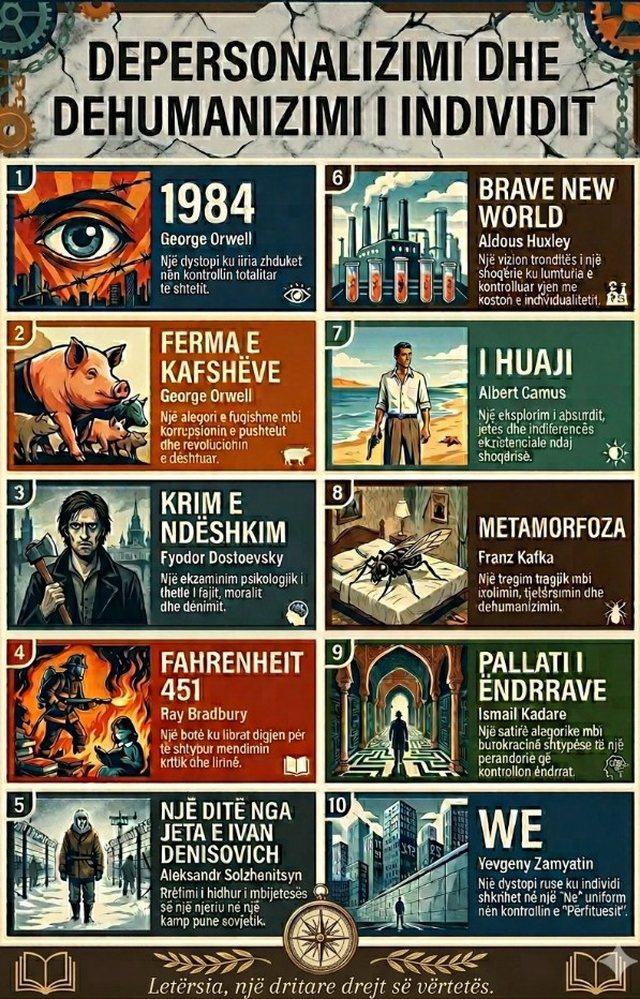
Depersonalization and dehumanization are two of the most sophisticated forms of violence against the individual. First, a person is stripped of their identity, then their dignity, then their voice, and finally their awareness of being a human being. They are no longer treated as a person, but as a number, a mechanism, a body of work, a soldier, a vote, a consumer, or an enemy.
Literature has warned of this tragedy repeatedly and long before modern societies experienced it in its wildest forms, turning the oppressed man into the most dramatic figure of modern art. And books that once seemed like dystopian fantasy are now read as chronicles of reality.
In George Orwell's 1984, depersonalization begins with thought control. The individual disappears under total surveillance. Man no longer has the right to remember, to doubt, or to have spiritual intimacy. "Big Brother" does not just demand obedience; it demands the extinction of individuality. Winston Smith is not tortured simply to physically subdue him, but to destroy his identity. Winston no longer thinks for himself. He becomes a product of power. This is the highest form of dehumanization: when man loses even his inner rebellion.
In "Animal Farm," dehumanization comes through political manipulation and propaganda. The animals start a revolution for freedom and end up in a system where pigs become more oppressive than humans. The crowd loses its memory and individuality, becoming an instrument of power.
In Franz Kafka’s “The Trial” and “The Castle,” the individual disappears into bureaucratic absurdity. Kafka realized early on that uncontrolled bureaucracy need not only kill you physically; it is enough to strip you of the meaning of existence. Josef K. is arrested without knowing the reason and wanders in a system where no one gives explanations. He is no longer a citizen, but a procedural object. Josef K. or the character K. do not fight against a concrete enemy, but against an anonymous and incomprehensible system. This is the modern form of dehumanization: a person is not killed, but gradually loses the meaning of his existence.
In “The Metamorphosis,” Gregor Zamza is transformed into an insect, but the real horror is the family’s reaction. As soon as he no longer produces economically, he loses his human value. Kafka strikes a universal truth: utilitarian societies measure man by his economic or social function, and that dehumanization begins as soon as man no longer produces, society begins to treat him as waste.
In Aldous Huxley's Brave New World, the individual is not oppressed by fear, but by comfort, consumption, and artificial pleasure. Society produces identical people, without pain, without critical thought, and without individuality. The dehumanization here is more elegant: people do not realize that they are slaves. A people that thinks only about consumption gradually forgets to think as individuals.
Another extraordinary example is Ray Bradbury's "Fahrenheit 451." Books are burned because critical thinking is considered dangerous. Society is endlessly amused by not thinking. Man is not oppressed by violence, but by intellectual emptiness. The less thinking, the less individuality.
In Yevgeny Zamyatin's "We," citizens have no names, but numbers. Personal identity itself is considered a threat to the state. Love, fantasy, and intimacy are treated as diseases. It is perhaps one of the clearest forms of totalitarian depersonalization in literature.
In Aleksandr Solzhenitsyn's "One Day in the Life of Ivan Denisovich," the Soviet labor camp reduces people to survival instincts. The name is replaced by the number. Yet Solzhenitsyn shows that even in the most inhuman conditions, the individual tries to retain a shred of identity.
In Albert Camus' novel The Stranger, Meursault appears emotionally detached from the world. Society condemns him not only for his crime, but also for not behaving according to the emotional norms of the crowd. Camus shows that society often dehumanizes anyone who does not fit into the collective stereotype.
In William Golding's "Lord of the Flies," children isolated from civilization gradually slide into barbarism. Moral identity disintegrates and the crowd produces primitive violence. Golding warns that dehumanization comes not only from power, but also from the collective instinct of the crowd.
Fyodor Dostoevsky’s “Crime and Punishment” also touches on this theme. Raskolnikov tries to convince himself that some people have no human value and can be sacrificed for a “greater purpose.” This logic is the foundation of all political dehumanization: when some people are considered less human than others.
In Albanian literature, Ismail Kadare's "Dream Palace" remains the most powerful allegory of depersonalization by the totalitarian state that controls not only life, but also the unconscious of the individual. The empire controls not only people's lives, but also their dreams. The individual no longer has even the last territory of freedom: the unconscious mind. Man is reduced to information to be monitored and classified. In this mechanism, fear becomes collective identity.
While in "Concert at the End of Winter", the individual often faces political machines that reduce him to an ideological figure.
The same goes for the novel "The Rise and Fall of Comrade Zylo" by D. Agolli.
The comparison between these works shows that dehumanization takes different forms:
* in dictatorships through fear,
* in bureaucracy through absurdity,
* in capitalism through utilitarianism,
* in society consumption through entertainment,
* in the crowd through collective instinct,
* in ideology through the disappearance of the individual.
But the end is always the same: the man loses his face.
And perhaps this is why great literature remains so important and is a wake-up call. Because it reminds society that the moment the individual ceases to be a human being and turns into a number, a crowd, or a tool, is the moment when modern barbarism begins.
Thus, literature is not simply art, but a defense of human individuality. Because every era that begins to produce identical, obedient people, without critical thinking and without identity, gradually begins to produce dehumanization.
Today this topic is even more relevant. Social networks create digital crowds where the individual is reduced to a faceless profile or algorithm. Politics treats citizens as votes. The economy as consumers. The media as clicks. And meanwhile, man, by learning to live as a statistic, risks forgetting that he is a being with conscience and free will.
That is why great literature remains immortal. Because it reminds man of what power, crowds, and systems constantly try to take away from him: his face, his name, and his soul./ CNA


Albania is today facing a monumental geopolitical crossroa...

Work is underway in the Poshë Poro-Nartë protected natural...

According to government propaganda, Brussels is stunned by...
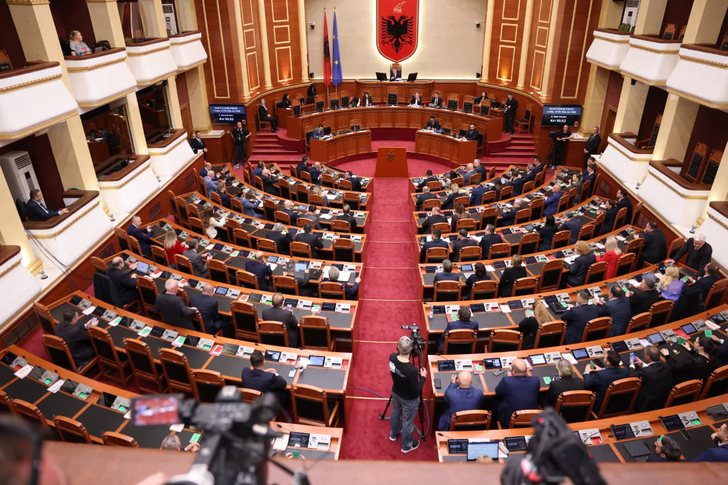
The Albanian Parliament has a very low intellectual level ...
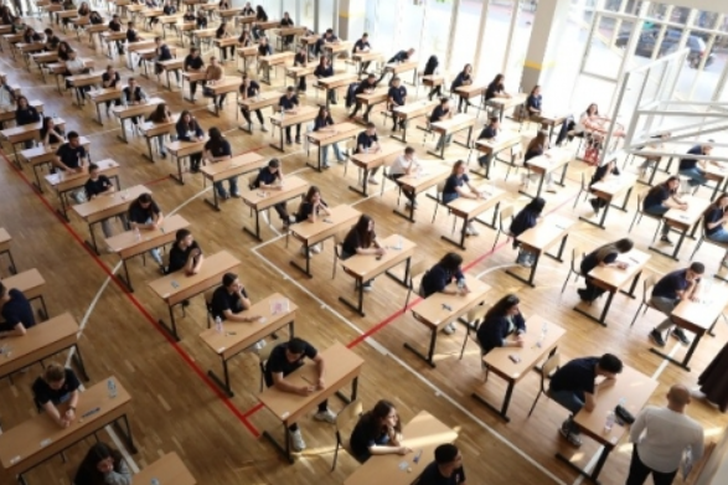
A high school senior asked me today why, for so many years...

Kjo pyetje shtrohet teksa jetojmë në një periudhë tranzici...

Yesterday, a young man, about 19-20 years old, had publish...

Dy herë përsëriti Edi Rama sot një gënjeshtër aq të pacipë, ...

On Friday I headed towards the southern coast. As soon as ...

A people can embrace an ideology only when it gives them hop...

In the contemporary debate on literature, one of the most ...
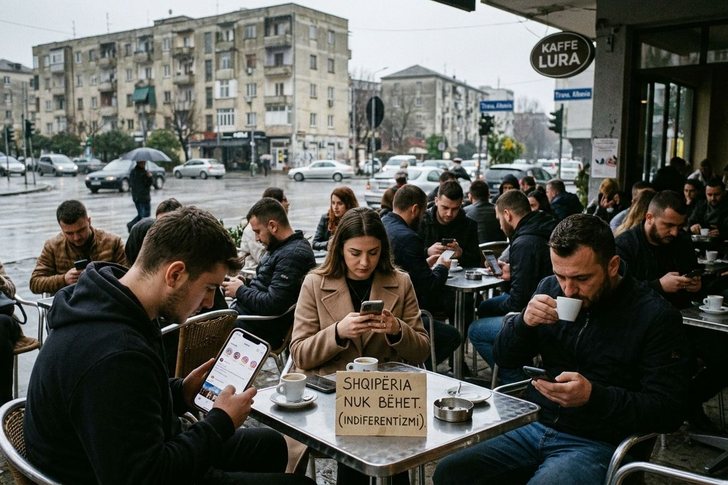
Albanians may not be able to build serious institutions. ...
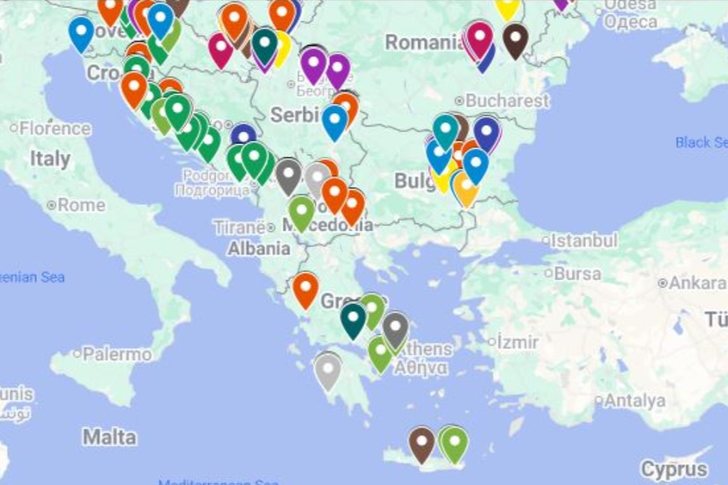
A new study launched in August 2025 and published in the w...

There is a special 24-hour sound in Tirana. It's the soun...

Hit the teachers! Yes, yes, don't stop. Don't stop... Denig...

There comes a moment in every political story when metapho...

I chose not to speak out immediately after the event in Du...

The European Parliament approved the report on Albania, wi...

Sunday, May 3, 2026 will remain a sad day in the chronicle...

April 2026 brought news that seemed like a step towards de...
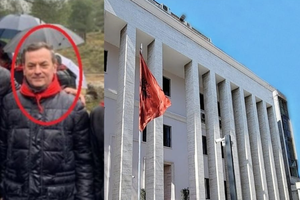
CNA has put under scanner the assets of Sokol Sadushi, the...

A 39-year-old citizen has been arrested in Lezha, after se...

CNA has launched another investigation that could lead to ...

Irfan Hysenbelliu is a businessman that we call "Irfan the...

The Special Board of Appeal (KPA) decided this Monday ...

The KPA vetting decided this Thursday to dismiss the p...

Suela Salavaçi, a prosecutor in the Prosecutor's Offic...

The Special Board of Appeal reinstated the prosecutor ...

Police have revealed details of the incident that occurred...
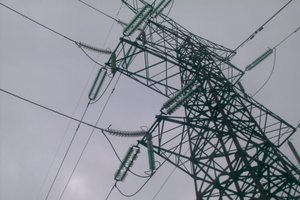
According to preliminary information, a person in his 60s ...

A triple accident occurred on the Peqin-Elbasan axis n...

The police have provided details regarding the accident th...

The public sector took the lead in absorbing the workforce...

Today, our country will be under the influence of unstable...
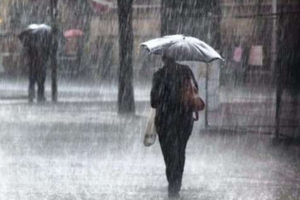
The Institute of Geosciences has today shared a forecast r...

Company leaders can improve productivity by investing in a...
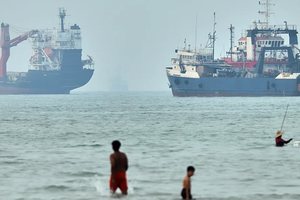
Oil prices fell in early trading on Monday, falling furthe...

Although Albania does not have a developed industry on the...

North Korea is said to have achieved some impressive resul...

US Ambassador to the United Nations, Mike Waltz, said toda...

Two windows, a century of history and the metaphysics of p...
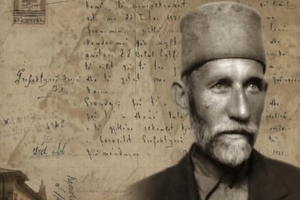
In my research at the Central State Archives, specifically...

At a time when industrial products are increasingly taking...

Trust among people is not just a three-syllable word. It c...

After strong savings growth in the years following the pan...

This Monday, one US dollar is bought for 81.5 lek and sold...

This Sunday, one US dollar is bought for 81.5 lek and sold...

This Saturday, one US dollar is bought for 81.7 lek and so...