


World Press Freedom Day/EU Declaration goes beyond rhetoric
May 3 is World Press Freedom Day, the European Union's dec...


April 2026 brought news that seemed like a step towards democracy: the Socialist Party was "open" to the opposition's demand for national proportional representation with open lists, but with one small, almost technical condition: reducing the number of deputies from 140 to 100. A concession for a concession.
It is essentially a well-thought-out pact.
At first glance, the national proportional system sounds like equality: every vote has the same weight, everywhere in Albania. There are no more districts that “kill” certain votes, there are no more big differences between zones. But the moment the number of deputies decreases, the real threshold for entering Parliament automatically increases. Not the formal threshold that could be, for example, 3%, but the real one that results from the distribution of mandates.
Open lists? Even better, the citizen chooses the individual, not just the party. A democratic dream on paper. But this dream begins to crumble the moment the number 100 is introduced into the equation.
Because democracy is not just about how votes are counted, but also how many seats there are to translate them into representation.
When the Assembly shrinks from 140 to 100 seats, each seat becomes more expensive. In simple terms: the real threshold for entering Parliament increases. Not the formal one written in law, but the one dictated by mathematics. With 100 deputies, a small party that could hope to secure a seat in a given district with a modest percentage must receive a much higher percentage of votes nationally to secure even one seat. And this, in a political market dominated by two giant electoral machines, is almost mission impossible. So, the new system does not ban small parties, it makes them irrelevant.
This is the first blow: elimination through mathematics.
The second blow is psychological. The voter, already tired of experiments that do not produce results, becomes rational in the most cynical way possible: he does not vote for what he believes in, but for what has a chance of winning according to probability. This creates the effect known as the “lost vote”. The vote becomes a bet, not a representation. And in this bet, the majority chooses not to “lose” the vote to a small force that has no real chance of obtaining mandates and abandons them in advance. Thus, small parties do not only disappear from the Assembly, they disappear from the political scene altogether. So, the system itself produces the result it claims to reflect.
The third blow is political: the concentration of power. When the competition is reduced to two main actors, every election turns into a closed duel. The two main parties, the Socialist Party and the Democratic Party, become the only real gateways to enter Parliament. Every other force must either merge with them or remain outside. Political alternatives do not disappear by law, but by mathematics. And, practically, there is no more room for alternatives, for new ideas, for correcting the system from within. Small parties, which often serve as moral or political pressure on the big ones, disappear. And with them, the fear of accountability disappears. Political alternatives do not disappear by law, but by mathematics.
The result? A system that appears pluralistic, but functions like a pure duopoly.
The irony is that this reform is sold as an improvement in democracy. In fact, it is a rationalization of control. A way of saying: “We will have elections, but no surprises.”
Because surprises come from the little ones. And in this new system, the little ones have no place anymore.
Open lists? A seemingly idealized version of this structure. They create internal competition within the major parties, but do nothing to change the relationship between the parties. They simply further fragment the internal opposition and make the competition for a place on the list more fierce, while the gate of entry remains closed to anyone outside the two main blocs.
And the result is clear: a system that seems more proportional, but is more exclusionary; that seems more open, but is more closed. The two major parties consolidate their dominance, while any other alternative is forced to either join them or remain out of the game.
The irony is that this reform can be sold as a modernization of democracy. In reality, it is a rationalization of control. When you reduce the number of seats and raise the price of admission, you are no longer representing, but selecting.
And this is a more elegant way of reaching the same conclusion: a cemented two-party system, where rotation is possible, but alternatives are not.

May 3 is World Press Freedom Day, the European Union's dec...

After 13 years in power, the government has also run out o...

In a month, the DP membership will vote to elect its chair...

Weekend status, 2.05.2026 The May 23, 2026 Democratic Par...

From 2025, Kosovo is heading to three elections, an excess...

In a race where there is only one candidate, coming in sec...

Last night, at 9:00 PM, I had a long conversation in t...

While the propaganda for the uncompromising fight against ...

There's no need to invent fake candidacies out of thin air...

Falenderuesi i atëhershëm i Ramiz Alisë është çimentuesi i...

"Shut up. Don't object! We invested in you, not you in the p...

I came across a post from the Municipality of Kukes this w...

There is a tendency in recent days to see the "glass cage"...

The news that a kilogram of cherries in Tirana went on the...

At the height of World War II, Prime Minister Mustafa Merl...

Two words cannot coexist in the same sentence without clas...

These days, an iconic woman of the anti-communist resistan...
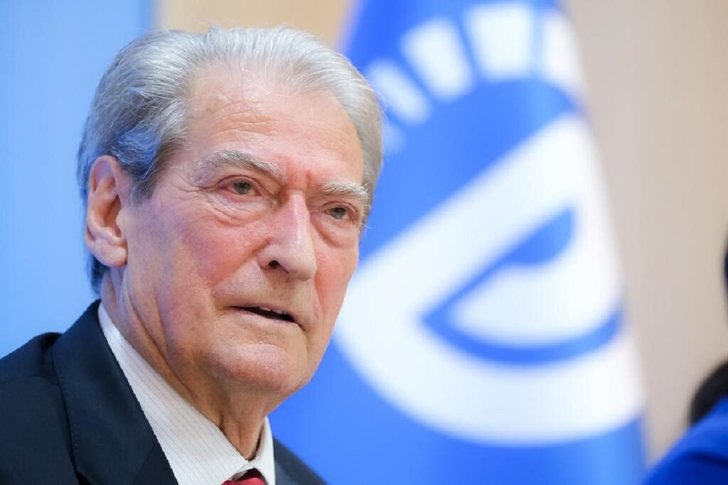
In a normal country, failure produces reflection. In Alban...

Odysseus searched for years to return to Ithaca. But perha...
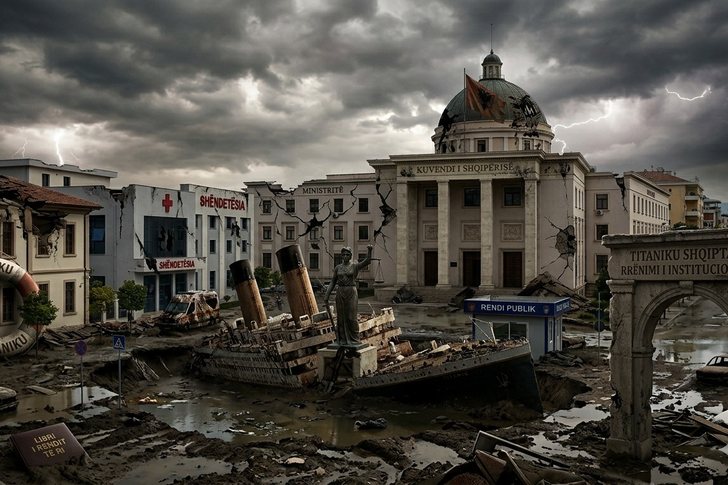
In April 1912, the Titanic, a marvel of engineering and sc...
A complaint to CNA also led to the publication of several ...

A mountain of documents for a flagrant case, in the na...

The Democratic Party has denounced a tender held by the Hi...
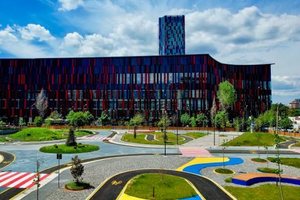
Since the summer of 2020, the Mayor of Tirana, Erion Velia...

The Special Board of Appeal (KPA) decided this Monday ...

The KPA vetting decided this Thursday to dismiss the p...

Suela Salavaçi, a prosecutor in the Prosecutor's Offic...

The Special Board of Appeal reinstated the prosecutor ...

A road accident occurred this afternoon in the former Këne...

A Border Police operation came to the aid of a citizen who...
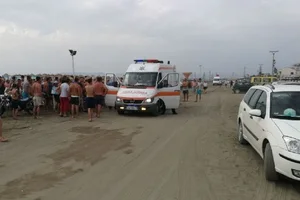
It is reported that a person drowned this afternoon on the...

Jetmir Pepa, known as Mir Pepa, has been arrested in Dubai...

Turkish police said on Tuesday they had arrested more than...

Today, our country will be affected by relatively stable w...

Albania is facing significant challenges in human capital ...
On Monday, our country will be affected by relatively stab...

US President Donald Trump will present the trophy to the w...

Germany will gradually raise the retirement age to around ...

Today marks 10 years since the referendum in which the Bri...

Andy Burnham has had a secret meeting with Keir Starmer to...
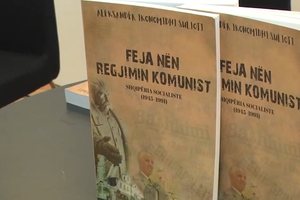
The promotion of the book by author Aleksandër Ikonomidhi ...

The Albanian Embassy in Switzerland has organized an eveni...
This Wednesday, the prominent actor of Albanian cinema, Gj...

Several archaeological excavations conducted during this s...

The labor market in Albania continues to be characterized ...

The two most frequently mentioned economic engines are con...

If you want to take the pulse of the economy, it's not eno...

One of the topics that has most shaken the economy is the ...