


Blinken, in Israel for the cease-fire in Gaza
US Secretary of State Antony Blinken will be in Israel on ...



Immigrants are becoming more and more unwanted.
More than half of Americans want "the deportation of all immigrants living illegally on American soil," up from one-third in 2016.
Only 10% of Australians want more immigration, a sharp drop from a few years ago.
Keir Starmer, Britain's new centre-left prime minister, wants his country to be "less reliant on immigration, training more British workers".
Australia's prime minister, Anthony Albanese, recently said his country's immigration system was "not working as it should" and that he wanted to halve net immigration.
Meanwhile, Donald Trump promises mass deportations if he wins the US presidential election.
These are not just words. Australia, Britain and Canada are targeting free universities that offer simple courses to people whose real purpose is to work in these countries.
This year, Canada hopes to cut the number of study permits by a third. Other states are making it harder for immigrants to bring their families with them.
President Joe Biden has announced measures to stop people from illegally crossing America's southern border from receiving asylum. The president of France, Emmanuel Macron, wants to speed up deportations from the country.
Germany is also implementing similar plans. In the future, stricter measures may come in all developed countries.
Mr Trump's plans mean the departure of perhaps 7.5 million people. What will all this mean for the economies of rich countries?
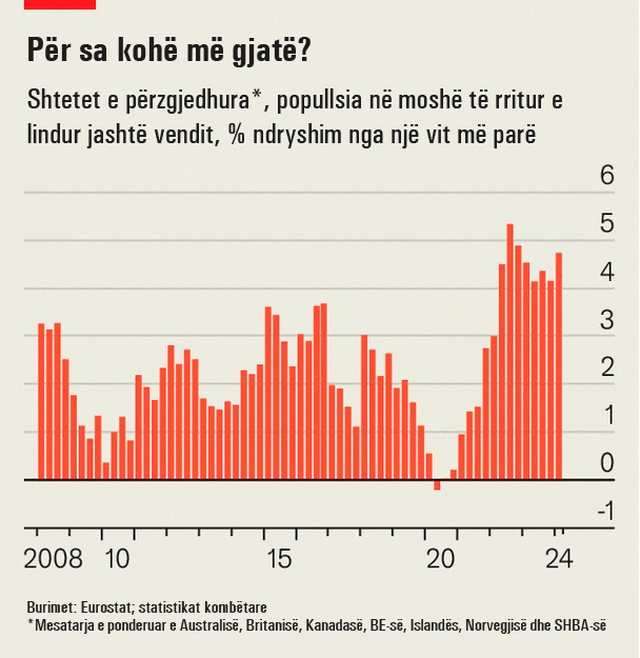
The change in approach comes after a period of very high emigration. In the past three years, 15 million people have moved to rich countries, the largest increase in modern history.
Last year, more than 3 million people immigrated to America, 1.3 million to Canada and about 700,000 to Britain.
The arrivals come from all over, including hundreds of thousands of Ukrainians fleeing war and millions from India and sub-Saharan Africa.
Now there are signs that this immigration boom may be coming to an end. Net immigration to Canada has almost halved since the last peak, and in New Zealand, it is also falling sharply. Rich countries have fewer job vacancies than before, giving immigrants less reason to move.
The influx of refugees from Ukraine has slowed. New anti-immigrant measures are also starting to take effect.
In the EU, the number of third-country nationals who returned to their home country after being ordered to leave has increased by 50% over the past two years.
Në tremujorin e parë të vitit 2024, “kthimet e detyrueshme” nga Britania, u rritën me 50% në bazë vjetore. Kalimet e paligjshme në kufirin jugor të Amerikës, së fundmi ranë në nivelin më të ulët në tre vjet.
Disa masa kundër emigracionit, veçanërisht dëbimet në shkallë të gjerë, mund të jenë jashtëzakonisht të dëmshme për ekonomitë.
Kur Kanadaja rriti deportimet gjatë periudhës së Depresionit të Madh, ajo vuajti një kosto të madhe fiskale. Në vitin 1972, qeveria e Ugandës dëboi me mijëra njerëz me origjinë aziatike.
“Praktikisht nuk ka mbetur asnjë sipërmarrës afrikan për të bërë tregti”, u raportua në një memorandum konfidencial të CIA-s atë vit.
Raporti gjithashtu vuri në dukje se ishte bërë e pamundur të prisje flokët në Kampala, pasi të gjithë dyqanet e berberëve ishin mbyllur.
Personat e afërt me Donald Trump argumentojnë se “Operacioni Wetback” siç u quajt në mënyrë tallëse politika e ish-presidentit Dwight Eisenhower në vitet 1950, që dëboi me mijëra meksikanë pa dokumente, tregon se dëbimet masive mund të funksionojnë pa pasur efekte të këqija.
Është e vërtetë se ajo ishte një periudhë e rritjes së fortë ekonomike dhe inflacioni mbeti i ulët. Sidoqoftë, krahasimi është mashtrues. Gjatë viteve 1950, emigracioni i ligjshëm i meksikanëve në Amerikë u rrit ndjeshëm.
Nuk ka dyshim se propozimi i Trump për dëbime në masë, do të shkaktonte kaos ekonomik, sepse industri të tëra do të detyroheshin të gjenin staf të ri.
Warwick McKibbin, nga Instituti Peterson për Ekonominë Ndërkombëtare, mendon se në rast se zoti Trump arrin të deportojë me sukses 7.5 milionë njerëz, PBB-ja amerikane do të ulej me 12% gjatë tre viteve.
Për sa u përket politikave më të moderuara për uljen e emigracionit, është ende e paqartë nëse mund të kenë ndikime pozitive apo negative në ekonomi.
Në një plan afatshkurtër, përpjekjet për të pakësuar emigracionin tepër të lartë, ndoshta do të ulnin inflacionin në tregun e banesave. Hulumtimi nga Banka Goldman Sachs tregon se në Australi, çdo rënie e emigracionit vjetor neto prej 100,000 vetash, do të ulte qiratë me rreth 1%.
Ndërsa emigracioni në Britani është ngadalësuar në muajt e fundit, po ashtu është ngadalësuar edhe ritmi i rritjes së qirave (faktorë të tjerë luajnë gjithashtu një rol).
Sidoqoftë, me kalimin e kohës, rënia e emigracionit ndoshta do të nxiste inflacionin gjetiu. Me rënien e ofertës së punës, pagat mund të rriten më shpejt, duke rritur çmimin e shërbimeve si hoteleria.
Shtrëngimi i emigracionit mund të rriste edhe PBB-në për frymë të vendeve, që është kriteri që përdoret zakonisht për të matur standardet e jetesës.
Për shembull, në Britani, ndërsa emigracioni u rrit në vitet 2022 dhe 2023, PBB-ja për frymë ra. Ka rënë edhe në Gjermani. Në Kanada, ka rënë edhe më ndjeshëm.
Kjo ka ndodhur pjesërisht, sepse të ardhurit e fundit janë në përgjithësi më pak të aftë se sa popullsia vendase, që do të thotë se ata nuk mund të kenë paga të larta.
Although this is a mechanical effect rather than a real hit to native living standards, the reduction in immigration could stop the slide in GDP per capita in the short term.
But there would be long-term costs. New arrivals are finding work. For decades, immigrants to Britain were less likely than natives to work. This is no longer true.
Now the employment rate of immigrants in Europe is the same as that of natives. Immigrants in America have long been more likely to work than the native-born, and in recent months, that gap has widened.
The immigration shock risks provoking a re-emergence of the labor shortages that plagued rich-country economies in 2021 and 2022, and which reduced GDP per capita, creating inefficiencies.
In the long run, immigration brings even more specialization to the workforce.
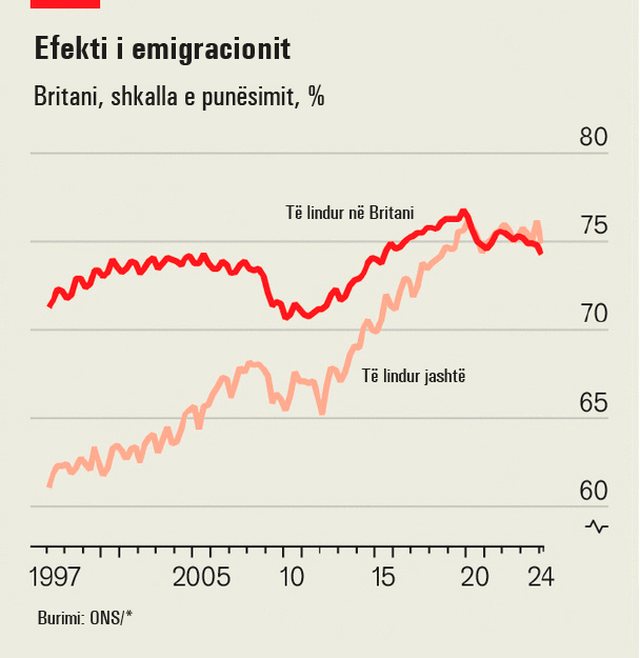
Most importantly, new arrivals often work in low-wage but vital industries, including construction and health care.
From 2019 to 2023, the number of foreign-born people in America's construction workforce increased significantly, even as the number of domestic builders declined.
In Norway, the number of foreign workers employed in healthcare has increased by 20% since the Covid-19 pandemic.
The number of doctors working in Ireland but trained elsewhere has increased by 28%.
Over the same period, the number of Chinese staff in Britain's National Health Service has doubled, while the number of Kenyans has tripled.
Over time, rich countries, which have aging populations, will need more young and eager workers.
This will happen because few politicians are now talking about measures like greatly increasing the retirement age, or making health care much more efficient.
Although cracking down on immigration may give politicians support for a while, this policy will become unsatisfactory for economies in the long run./ Monitor.al

US Secretary of State Antony Blinken will be in Israel on ...
Israel's negotiating team expressed "reserved optimism" ab...

Security at Ukraine's occupied Zaporizhia nuclear power pl...

In 2022, the number of births in the European Union reache...

A spacecraft docked with the International Space Station (...

Two Italian journalists who drew the ire of Moscow aft...

The Basic Prosecutor's Office of Ferizaj in Kosovo has req...

Chechen leader Ramzan Kadyrov has posted a video in wh...

The US State Department (Dash) said that any assertion...

The Vice President of the United States, Kamala Harris...

The President of Serbia, Aleksandar Vučić, has spoken ...

The tragedy that leaves you speechless, the Greek medi...

The Greek authorities raised to IV the fire danger level f...

Leaders of Hamas have reacted on Saturday regarding th...

After the reports about last night's murder in Ferizaj...

Ukrainian President Volodymyr Zelensky said his troops...

At least nine people have been killed and five others woun...

Russia's Foreign Ministry said Ukraine had used Western mi...

Firefighters are battling wildfires in Turkey's Izmir for ...

Talks in Doha, Qatar on reaching a Gaza ceasefire broke do...

Dritan Prençi is the SPAK prosecutor who is sleeping on th...

The in-depth investigations that SPAK conducted into Ajola...

SPAK's standards, the way it investigates, how it secures ...

Irfan Hysenbelliu claims to be a big businessman, an hones...

The Special Board of Appeal (KPA) decided this Monday ...

The KPA vetting decided this Thursday to dismiss the p...

Suela Salavaçi, a prosecutor in the Prosecutor's Offic...

The Special Board of Appeal reinstated the prosecutor ...

A road accident was recorded a few minutes ago on the Pogr...

The State Police has published new footage from the operat...

A TNT explosion has occurred in the village of Balldren i ...

Gunfire broke out this morning in Lezha. According to repo...

Albania is facing a deep demographic crisis where official...

This Wednesday, our country will be affected by relatively...

The UN's World Meteorological Organization now warns that ...

Intense rainfall has caused numerous problems in the Radom...
Prices in the US in May rose at their fastest pace in thre...

Billionaire Bill Gates will appear today before a US Congr...

Pope Leo XIV visited one of Spain's largest prisons on Wed...

US President Donald Trump said Iran's military has been "t...

Korça has transformed this weekend into the capital of cel...

Korça is ready to open the summer season with one of the c...

Two years after his passing, the renowned Korçë poet Skënd...

The Ethnographic Museum of Berat has opened its doors to v...

The non-performing loan ratio returned to decline in April...

This Wednesday, one US dollar is bought for 81.6 lek and s...

The 2025 turnover reassessment for businesses in Tirana ha...

Predictions of a severe oil shortage this summer have not ...