


Investigation/ The company that took public areas from the Municipality of Tirana is revealed
In March 2026, CNA launched another investigation centered...

In March 2026, CNA launched another investigation centered...

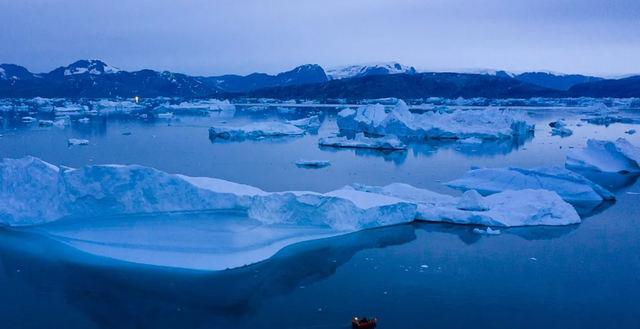
Melting glaciers and thermal expansion are driving the 'acceleration' of sea level rise to record levels.
Sea levels are rising faster than at any other time in the last 4,000 years, highlighting the urgent need for global and local action.
New research has warned that climate change and human activities are driving increased flooding, posing a serious flood threat to major cities around the world.
The report says that while rising sea levels are a global problem, China faces a double threat, as its largest and most economically important cities are particularly prone to sinking.
How fast are sea levels rising?
Scientists at Rutgers University examined thousands of geological records from various sources, including ancient coral reefs and mangroves, which are often used as a natural archive of past sea levels.
They reconstructed sea level changes dating back almost 12,000 years, to the beginning of the Holocene, the current geological epoch that began about 11,700 years ago, after the last major ice age ended.
Published in the journal Nature, the findings show that since 1900, global sea levels have risen at an average rate of 1.5 millimeters per year.
Why are sea levels rising?
The study describes two "major forces" that are driving the acceleration of sea level rise: thermal expansion and glacial melting.
As climate change raises the planet's temperature, the oceans are absorbing more heat and expanding. At the same time, ice sheets in the polar regions are melting at an unprecedented rate, adding more water to the oceans.
The Greenland ice sheet lost 80 billion tons of ice during the 12 months from September 2023 to August 2024, marking the 28th consecutive year it has lost more ice than it produces.
Currently one of the world's largest sources of freshwater, the Greenland ice sheet contains water that would cause the equivalent of 7.4 meters of global sea level rise.
For every centimeter of sea level rise, about six million people on the planet are exposed to coastal flooding.
Researchers warn that deltas, flat, fertile regions that are close to water, will be hit hardest by rising sea levels.
These areas are often used for agriculture, transportation and urban development, meaning their disappearance could cause weaknesses in the global supply chain./ CNA


The rabbit is a herbivorous mammal, feeding on grass, leav...

A toothbrush can be home to between 1 and 12 million bacte...

A robbery at the Louvre Museum in Paris made headlines aro...

A high-quality diamond weighing 340 carats has been uneart...

In the animal world, where speed is often associated with ...

Scientists, through a new discovery, have shown that the n...

Snow leopards are at high risk of extinction in the wild. ...

Pumpkin is one of the most beloved autumn vegetables. This...

American scientists have, for the first time, created earl...

German waters alone contain around 1.5 million metric tons...

A 40-year-old man in the city of Durres has been declared ...

An unknown portrait by Pablo Picasso of one of his girlfri...

In Scanno, a medieval village deep in the wild mountains o...

The small Croatian village of Jaskovo has earned its place...

For almost 80 years, the painting 'Portrait of a Lady' by ...

A total lunar eclipse will occur overnight Sunday (Septemb...

To test the water quality in a reservoir, workers typicall...

Fishermen off the Caribbean coast of Costa Rica have caugh...

An archaeology student from the US state of Florida has di...

The Huajiang Canyon Bridge is a suspension bridge in Guizh...

In March 2026, CNA launched another investigation centered...
The arrested mayor of Tirana, Erion Veliaj, with 13 charge...

CNA has uncovered the tentacles of the head of the Supreme...

The company "Gjikuria" has been caught in several serious ...

The Special Board of Appeal (KPA) decided this Monday ...

The KPA vetting decided this Thursday to dismiss the p...

Suela Salavaçi, a prosecutor in the Prosecutor's Offic...

The Special Board of Appeal reinstated the prosecutor ...

Three people have been arrested in Lezha after they forcib...

The Shkodra Court has imposed the security measure "House ...

Një ngjarje e rëndë raportohet se ka ndodhur në orët e par...

A serious road accident was recorded this afternoon on the...

On Monday, our country will be under the influence of rela...

On Sunday, our country will remain under the influence of ...

The World Health Organization described extreme heat in Eu...

Systematically in the last 15 years, circulatory system di...

More than 400 Ukrainian drones were launched overnight tow...

The next British Prime Minister, Andy Burnham, aims to str...

The United States Central Command (CENTCOM) said it has at...

The ceasefire between the United States and Iran has essen...

Trust among people is not just a three-syllable word. It c...

Master of humor Todi Llupi has passed away at the age of 7...

The ninth edition of "MIK Festival" kicked off with one of...

A historic evening for Albanian culture was marked in the ...

This Monday, one US dollar is bought for 81 lek and sold f...
In Golem and Durrës, the season seems dynamic: buses with ...

This Sunday, one US dollar is bought for 81 lek and sold f...
INSTAT statistics for May show an increase in tourism, wit...