


Marine life after World War II/ Submarine discovers living things in the Baltic Sea
German waters alone contain around 1.5 million metric tons...


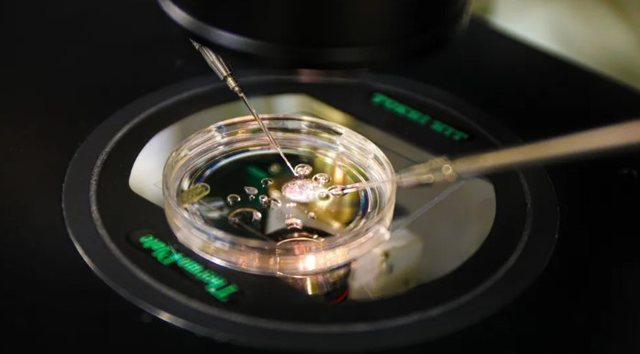
American scientists have, for the first time, created early-stage human embryos by manipulating DNA taken from human skin cells and then fertilizing it with sperm.
The technique can overcome infertility due to old age or disease, using almost every cell in the body as a starting point for life.
The method requires significant refinement, which could take a decade, before a fertility clinic can consider using it.
Experts said it was an impressive advance, but there needed to be an open discussion with the public about what science was making possible.
Reproduction used to be a simple story of a man's sperm meeting a woman's egg. They unite to form an embryo, and nine months later a baby is born.
Now scientists are changing the rules. This latest experiment starts with human skin.
The Oregon Health & Science University research team's technique takes the nucleus, which contains a copy of all the genetic code needed to build the body - from a skin cell.
This is then placed inside a donor egg that has had its genetic instructions removed.
So far, the technique is similar to that used to create Dolly the sheep, the world's first cloned mammal, born in 1996.
However, this egg is not ready to be fertilized by sperm as it already contains a complete set of chromosomes.
You inherit 23 of these DNA strands from each of your parents, for a total of 46, which the egg already has.
So the next stage is to convince the egg to shed half of its chromosomes in a process that researchers have called "mitomeiosis" (the word is a portmanteau of mitosis and meiosis, the two ways cells divide).
The study, published in the journal Nature Communications, showed that 82 functional eggs were created. These were fertilized with sperm and some progressed to the early stages of embryo development. None developed beyond the six-day stage.
"We achieved something that was thought to be impossible," said Prof Shoukhrat Mitalipov, director of the Center for Embryonic Cell and Gene Therapy at Oregon Health & Science University.
The technique is far from perfect, as the egg randomly chooses which chromosomes to shed. It should end up with one of each of the 23 types to prevent disease, but it ends up with two of some and none of others.
There is also a poor success rate (about 9%) and the chromosomes miss an important process where they rearrange their DNA, called crossover.
Prof. Mitalipov, a world-renowned pioneer in this field, told me: "We need to perfect it."
"Ultimately, I think that's where the future is going, because there are more and more patients who can't have children."
This technology is part of a growing field that aims to create sperm and eggs outside the body, known as in vitro gametogenesis.
The approach is still at the level of scientific discovery and not clinical use, but the vision is to help couples who cannot benefit from IVF (in vitro fertilization) because they do not have sperm or eggs to use.
It can help older women who no longer have viable eggs, men who don't produce enough sperm, or people whose cancer treatment has left them infertile.
This field is also rewriting the rules of parenting. The technique described today doesn't have to use a woman's skin cells - it can use a man's too.
This opens the door for same-sex couples to have children who are genetically related to both partners. For example, in a male same-sex couple, one man's skin can be used to produce the egg and the sperm of a male partner is used to fertilize it.
"In addition to offering hope to millions of people with infertility due to a lack of eggs or sperm, this method would allow the possibility for same-sex couples to have a child genetically related to both partners," said Prof. Paula Amato, from Oregon Health & Science University.
Build public trust
Roger Sturmey, professor of reproductive medicine at the University of Hull, said the science was "important" and "impressive".
He added: "At the same time, such research reinforces the importance of ongoing open dialogue with the public about new advances in reproductive research."
"Such advances remind us of the need for strong governance, to ensure accountability and build public trust."
Professor Richard Anderson, deputy director of the MRC Centre for Reproductive Health at the University of Edinburgh, said the ability to generate new eggs "would be a major breakthrough".
He said: "There will be very significant safety concerns, but this study is a step towards helping many women have their genetic children."/ CNA, translated by BBC

German waters alone contain around 1.5 million metric tons...

A 40-year-old man in the city of Durres has been declared ...

An unknown portrait by Pablo Picasso of one of his girlfri...

In Scanno, a medieval village deep in the wild mountains o...

The small Croatian village of Jaskovo has earned its place...

For almost 80 years, the painting 'Portrait of a Lady' by ...

A total lunar eclipse will occur overnight Sunday (Septemb...

To test the water quality in a reservoir, workers typicall...

Fishermen off the Caribbean coast of Costa Rica have caugh...

An archaeology student from the US state of Florida has di...

The Huajiang Canyon Bridge is a suspension bridge in Guizh...

Grease stains on clothes are one of the most stubborn prob...

Scientists analyzed over a billion social media posts to d...

A new moon will occur at 2:06 a.m. Eastern Time on August ...

NASA's Webb Space Telescope has found a new small moon aro...

For centuries, the moon and how it influences human behavi...

Centuripe, a city in Sicily, is known for its unique, huma...

The Perseid meteor shower is expected to peak in mid-Augus...

More than 50 years after his death, JRR Tolkien's fantasy ...

New evidence strongly suggests that Pompeii was repopulate...

CNA has launched another investigation that could lead to ...

Irfan Hysenbelliu is a businessman that we call "Irfan the...

In March 2026, CNA launched another investigation centered...
The arrested mayor of Tirana, Erion Veliaj, with 13 charge...

The Special Board of Appeal (KPA) decided this Monday ...

The KPA vetting decided this Thursday to dismiss the p...

Suela Salavaçi, a prosecutor in the Prosecutor's Offic...

The Special Board of Appeal reinstated the prosecutor ...

A road accident occurred this evening on Nikolla Zoraqi St...

Three people were shot and wounded in Elbasan last night b...

A serious incident occurred this Tuesday in the Yrshek are...

An accident occurred this Tuesday on "Dituria" street in K...

All of Southern Europe will face changing weather conditio...

Albania was hit by temperatures significantly higher than ...

For the first time, Pogradec welcomed the Inter-Lake Chess...

Albania has achieved a record for the employment of foreig...

US Secretary of State Marco Rubio arrived in Manila on Jul...

In the space of a few days, Ukrainian President Volodymyr ...

The spokesman for the Iranian Foreign Ministry warned Bulg...

Autoritetet italiane sekuestruan pako me afër 800 kilogram...

At a time when industrial products are increasingly taking...

Trust among people is not just a three-syllable word. It c...

Master of humor Todi Llupi has passed away at the age of 7...

The ninth edition of "MIK Festival" kicked off with one of...

Construction company licenses will have a validity period ...

The Centralized Purchasing Operator recently opened a tend...

The new draft law "On the Bank of Albania" provides that t...

This Tuesday, one US dollar is bought for 81.2 lek and sol...