


"We will make the Brazilian Albanian"/ Rama hands over the honorary award to Sylvinho
Tonight at the Sports Stars gala evening, Prime Minist...



Almost a third of the country's municipalities risk disappearing from the country's demographic map, as the number of births is heading towards zero, while the natural increase was negative in 82% of the municipalities in 2021. Last year, the number of births per 100 women in reproductive age reached 121 children from 132 in 2021. The fertility decline in Albania from 1990 to 2021 was three times higher than in 52 countries of Europe and Central Asia. The "Baby Bonus", a policy that the government undertook to encourage births failed, since from 2019, when its application began, until 2022, the number of babies decreased by 13.5%. Experts are calling for a package of measures to reduce the costs of raising children and support young families
The decline of the population at young ages is so strong that it has reached the proportions of an avalanche that nothing can stop now. The emptying of the country by young people for about three decades in a row is having cascading effects in the decline in the number of births and fertility rates.
Last year, the number of births per 100 women of reproductive age reached 121 children out of 132 children born in 2021, the sharpest drop since 2015 when the country was engulfed by a high tide of asylum seekers in EU countries . In 1990, 300 children were born to 100 women.
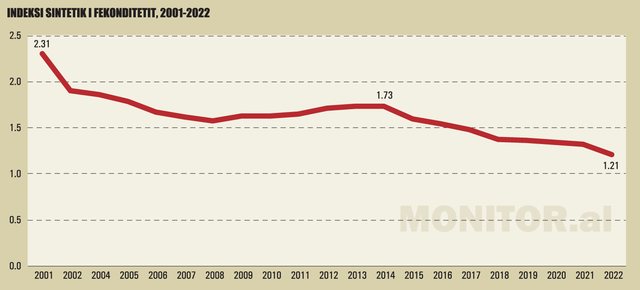
Almost a third of the country's municipalities are at risk of disappearing from the demographic map, as the number of births is going to zero, while the natural increase was negative in 82% of the municipalities in 2021.
Comparative data from the United Nations show that the decline in fertility in Albania from 1990 to 2021 was three times higher than in 52 countries of Europe and Central Asia. But while other countries anticipated the situation, offering social packages to slow down the decline, Albania is still not clear about the problem.
The lack of accurate data about the population living in the country, especially in the regions, is making all interventions difficult. The numerous movements of the population inside and outside the country and on the other hand, the postponement of the Census from 2020 to this year nullified all other indicators related to the population and the economy, at a time when the country has seen strong waves of immigration that from the last Census 2011.
Demographers believe that the fertility rate in Albania compared to the resident population is higher, but the lack of accurate data on the population makes it difficult to formulate tools for intervention.
The "Baby Bonus", a policy that the government undertook to encourage births failed, since from 2019, when its application began, until 2022, the number of babies decreased by 13.5%.
The experiences of European countries, which have suffered a decline in births before Albania, have shown that financial measures that are given only once and mainly when the child is born, are not efficient. We need social packages to help families and permanent support for some categories.
An example in this case is France, which through the Ministry of the Family has offered a very favorable social package that promotes birth rates, ranking this country with the highest fertility rate in Europe.
Ermira Galanxhi, one of the best-known experts in the country on demographic issues, says that the best tool to mitigate the consequences of the demographic transition is economic development, which must come through a deep reform in education and the economic model of development. of the country.
Albania should aim for rapid integration in the EU and in internal policies it should focus on creating opportunities for young age groups.
The training of young people, she said, should start from the early stages of education and on the other hand, the economy should be oriented towards branches where the country is more competitive.
According to Ms. Galanxhi, the growth of the tourism sector is a good moment for Albania and to orient professional education towards this sector, in order to prevent the flight of young people, therefore, the population indicators also improve.
The expert says that the economic development should be distributed towards the regions, as the population movements from the periphery to the center are inversely proportional to the economic resources. A balanced regional development and a package of pro-family policies would, in the longer term, improve fertility indicators.
Majlinda Nesturi, demography expert, consultant on gender issues at the United Nations office in Albania, says that the high costs associated with raising children, such as education, health care, housing and childcare, can discourage couples from have more children.
She advises family-friendly policies, financial incentives for large families and support for work-life balance.
A similar suggestion is given by sociologist Entela Binjaku, who says that a package of measures should be coordinated to help young people from the stage of studies and then, in creating a new family.
Almost a third of the country's municipalities are at risk of disappearing from the demographic map, as the number of births is going to zero, while the natural increase was negative in 77% of the municipalities in 2021.
The data from INSTAT show that some municipalities, mainly in the South, are at risk of depopulation, while the closure of schools is certain. In 2021, not a single baby was born in Pustec Municipality. In Dropulli, only 4 babies were born, or 50% less than in 2011.
In the same year, only 21 babies were born in the Municipality of Libohova, with a 57% decrease from 2011. The strongest decrease was in the Municipality of Fini?, where only 23 babies were born in 2021, or 74% less than in in 2011.
Since the 2011 Census, over a decade, in our country, the number of births at the national level dropped by 20%, but in 35 municipalities out of 62 in total, the drop in births was between 30-70%. The biggest drop in births resulted in the Municipality of Pustes, which had no births in 2021 from about 23 such in 2011.
The municipality of Tropoja ranked second for the drop in births during the decade, with 62%. Only 115 babies were born in the northeastern city, down from 303 in 2011.
In almost all municipalities, birth rates fell at double-digit rates, except for Tirana, which in 2021 had 6.7% more births than in 2011. The country's municipalities are suffering double immigration that has emptied them of reproductive ages.
This is very visible in small municipalities, where young people leave for emigration, for studies, or work in Tirana and never return.
Due to the low fertility rate, in most municipalities in the country, the natural increase of the population is negative, where deaths are much higher than births.
Almost 82% of the country's municipalities had negative natural increase in 2021, as deaths were much higher than births.
Local unit vital data is available for 2021, which was an unusual year for the mortality caused by the pandemic, with deaths nearly 30% higher than the 2016-2019 average.
Only 11 municipalities had a positive natural increase, where births were higher than deaths and they are mainly concentrated in the North of the country. With mortality returning to normal in 2023, now that the pandemic has passed, data on the natural increase remain troubling.
In the second quarter of 2023, five regions of the country recorded positive natural increase of the population, while in the other seven regions, the natural increase of the population is negative.
In the second quarter of 2023, the county with the highest natural increase is Tirana, with 699 more births than deaths, while the county with the lowest natural increase is Korça, with 184 more deaths than births.
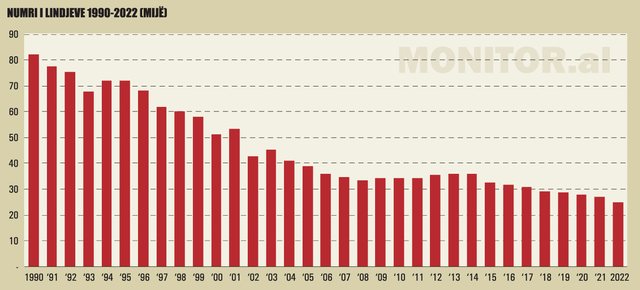
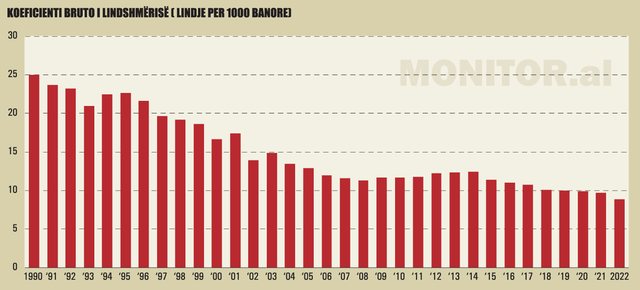
In addition to the sharp drop in births in 2022, several indicators in the female population that are the basis of reproduction also worsened. According to INSTAT data, in 2022, about 24,688 babies were born, or 9.3% fewer than in 2021. This was the steepest annual decline in fertility since 2000. But as fewer babies were born, the decline for female babies it was even stronger.
The sex ratio at birth is 107, which means that for every 100 girls born, 107 boys are born. This ratio is higher than the natural ratio, which is 105. This has worsened reproduction in the future.
The Gross Reproduction Coefficient (GRC) is a good indicator for measuring the growth of future generations, e.g. how many females are born out of 100 women of reproductive age. BRR measures the rate at which women replace themselves during their reproductive years. In 2022, the KBR is 0.59 which means that women in Albania are about 41% away from replacing themselves and this indicator has further deteriorated.
According to detailed data, the birth rate has decreased for the age groups of 20-24 and 25-29 years, while for the older age group of 35-39 years there has been a slight increase. In 2022, the average age at birth was 29.5 years.
Gender-specific fertility rates for 2022 show that men start childbearing relatively later than women, approximately 5 years later, while fertility rates after 30 are higher than women. .
In developed countries, which have experienced population decline before us, the combination of emigration and declining births, which cause population decline and change in its structure, can have harmful effects on the sustainable development of the country.
In an aging population, companies invest less for the future, as workers over 50 tend to accumulate savings to fund their retirement.
Interest rates fall and economic growth is curbed. Many economists have pointed to the aging of Western societies as a major explanation for low productivity growth and falling long-term interest rates.
The most illustrative case is Japan, where its growth cycle stalled when its working-age population began to shrink. An aging workforce is not capable of being innovative in technology and innovation, but instead requires a high burden of health and pension costs.
The lack of young people hinders the orientation of the economy towards more productive sectors, and the lack of productivity enables less income for old age.
The situation in Albania is getting worse due to the flight of young people. From last year until May 2023, a sharp decline in sugar and grain imports was seen by 30-50% on an annual basis.
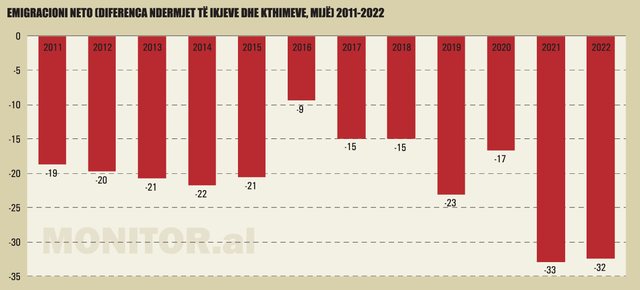
Wholesalers expressed concern and claimed that the decline was caused by a large exodus of the population at a young age. INSTAT reported that last year, net emigration, the difference between people who emigrated and those who returned, reached 32,400 people.
The same figure resulted in 2021, where the majority over 80% are young. The flight of 60,000 young people in two years, almost the size of Kukes District, gave chain effects in all sectors, from import, production, trade.
According to net migration data from 2011 to 2022, 246 thousand people have left the country, but another INSTAT method, which compares two data, the resident population and that of the civil registry, found that the number of immigrants living abroad increased by 600 thousand between 2011 and 2020.
Adi Haxhiymeri, from the Association of Flour Processors, one of the biggest importers of flour in the country, says that the consumption of doughs is decreasing year by year due to the decrease in the young population.
Young people are big consumers of pastries, sugar, alcoholic beverages and sweets, so their strong exodus in the last two years was felt in consumption, which only started to improve with the arrival of tourists in the country.
The same concern has been expressed by sugar wholesalers, who reported that sales in rural areas have suffered a significant decrease due to the shrinking population. In parallel with the decline in consumption, companies in all sectors declared an emergency for employees. Tourism, construction and companies in the manufacturing sector have started to be supplied with foreign workers.
The lack of human capital has now become a concern for the country's economic growth, as in the longer term, the pension system, social care and the quality of democracy, in the absence of a young population, will deteriorate.
The human resource crisis first appeared in fashion factories, but now it has spread rapidly to all sectors.
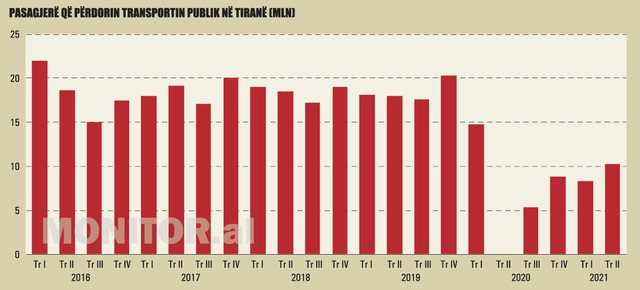
Major urban line operators in the capital said that currently, the number of passengers using urban transport in the capital fell by 53% between 2016 and the first six months of 2021 when the latest data was published.
The population has decreased, so even the insurance companies say that their activity is being extremely badly affected by emigration.
Forcim Kola, General Director of INSIG, says that the company is facing great challenges, related to staff limitations, difficulties to contact customers, low rates of the insurance market, as a result of the inhibition of individual activities and businesses.
In the 2010-2011 school year, 782 thousand pupils and students were enrolled in pre-university and higher education, while in the 2022-2023 academic year, this number was reduced to 545,222 or almost 30% less according to INSTAT data.
The reduction in the number of students in the following decade risks halving, since the number of births in 2022 was only 24 thousand babies, or 30% less than in 2011.
By 2032, it is expected that the education sector will be reduced by about 40%. For demographers and education experts, this is the time to raise the quality of teaching at all levels.
The expert on demographic issues, Ermira Galanxhi, says that quality education improves all other indicators from the economy and demography.
The former Minister of Education, Myqerem Tafaj, said that the decrease in the number of students should not lead to a reduction of funds in the education sector, but an increase in quality, through investments in the pedagogical and academic staff, in the educational infrastructure, programs and research scientific.
A good education offer can curb youth immigration and attract foreign students. Currently, for the education sector, investments are less than 3% of GDP, while UNESCO criteria require funding of no less than 5%.
The decrease in the ratio of teachers to students should increase the quality, says Mr. Tafaj, according to which teachers should be prepared and educated for teaching more than in one subject. The examples of other countries, especially those in Northern Europe, have shown that long-term investments in education are the best basis for improving well-being.
The rapid decline in the number of births and the flight of young people who may be born in the next 5 years are creating a high gap in schools. In the school year 2023-2024, less than 29,000 children were enrolled in the first grades, at a time when 6 years ago 30,800 babies were born.
Family immigration has significantly reduced the number of students in classes in the last 5 years. The phenomenon has also been visible in Tirana, for which surveys have shown that there was the highest number of immigrants organized with families during 2011-2019, according to a special survey on immigration that was conducted by INSTAT.
According to INSTAT's determinations, which are based on international methodology, a pensioner is considered poor if the monthly payment is less than half of the national average salary. This gap has deepened in recent years and has accelerated further this year.
In the first 6 months of 2023, the average pension was only 25.5% of the average gross monthly salary, from 31% in 2018.
In 2022, the average pension in the city was 44.4% of the average net salary and 35% of the gross salary. These ratios were respectively 52% and 41% in 2018.
The data show an increase in inequality between the layers of society, in this case pensioners and employed persons.
The gap is likely to widen in the coming years, as the market is signaling higher wage growth due to the new conditions created by the labor shortage.
After an anemic decade, wages have started to move, albeit not at high rates.
At the end of June 2023, the average salary nationwide was 30% higher than before the pandemic, increasing from 52,380 ALL to 67,805 ALL. In the same period, the average pension from the level of 16,256 ALL in 2019 reached 17,306 ALL in the first 6 months of this year, with an expansion of only 6%
The difference between the pension and the average salary is even deeper for the countryside. In 2022, the average pension in the village was 10,349 ALL according to official data from the Institute of Social Insurance. This amount was only 16.7% of the gross salary in the same period.
The difference between the average salary and the average pension is expected to deepen even more this year, as the government is increasing salaries for the public administration, with the aim of doubling them in the next two years, while only indexation is foreseen for pensions.
During this year, pensions were indexed by 8.6%. On the other hand, the number of pensioners, who do not complete their working years and do not manage to benefit from a full old-age pension, is growing rapidly.
Official data from the Institute of Social Insurance show that, in the first 6 months of 2023, pensioners with partial payment made up 50% of the total number of people who benefit from an old-age pension, up from 45% in 2021.
Populations in many countries in Eastern and Southern Europe are now declining, due to a combination of emigration and higher death rates than births.
For EU countries, which are suffering this problem earlier than our region, immigration is considered the easiest and most visible way to increase its population.
However, few politicians, especially in former communist countries, would accept this instrument in improving demographic indicators.
But, apart from immigration, some conservative governments in Europe have taken measures to improve births. Hungary is the latest to adopt radical measures to try to tackle the problem.
Prime Minister Viktor Orban has announced fertility clinics as a strategic sector. Young families are already offered a loan that they do not need to pay back if they have a third child. Women who have four children will be exempt from income tax for life.
Poland's conservative government introduced payments to encourage larger families. Its "Family 500+" program distributes 500 zlotys (€118) per month to low-income families for their first child and to each family for subsequent children.
In fact, the most successful measures aim to make life easier for working mothers: usually when forced to choose between raising children or a career, women have chosen to work.
The highest birth rates in Europe are in secular France, thanks to its generous spending on welfare and cheap childcare.
Successive governments have offered nurseries instead of fertility clinics.
Sweden comes second, thanks also to pro-family policies, as well as encouraging men to take more care of children. Policies have shown that it is possible to reverse the trend of low birth rates.
Germany, where measures to promote fertility were once taboo, has managed to raise the birth rate over the past decade.
In part this reflects the recent influx of refugees, especially Syrians who tend to have large families. Germany made efforts to make life easier for working women.
During her tenure as Germany's Family Minister, Ursula Von Der Leyen introduced successful childcare and parental leave policies.
The reforms helped raise the fertility rate from 1.33 children per woman in 2007 to 1.57 in 2017, according to Eurostat data.
Meanwhile, global birth rates continue to fall faster than expected. On average, people around the world want about two children.
In middle and high income countries, of which Albania is also a part, the situation is controversial. Fewer children are born in these families than they would like. This happens in countries where most families enjoy a relatively high standard of living.
So far, some governments in Europe have declared a "national emergency" over low birth rates, while others have turned a blind eye. Either way, policymakers are in a tricky situation: fertility policies that worked in the 20th century may no longer be effective.
Fortunately, there is already a body of demographic and family policy studies that show which tactics are worth pursuing and which are not.
Recent studies show that aspirations to have children are fueled by social trust and individual resilience and weakened by political polarization and other modern afflictions, including the influence of social media./ Monitor.al

Tonight at the Sports Stars gala evening, Prime Minist...

The Minister of Education and Sports, Ogerta Manastirl...

The former deputy and member of the Presidency of the ...

The bad weather, accompanied by snowfall and wind, has...

After the bluff of the opposition, which published sev...

The snowfall that has fallen in the last 24 hours and ...
The Minister of Infrastructure and Energy, Belinda Bal...

Prime Minister Edi Rama gave a speech at the evening o...

Kryeministri Edi Rama, i cili mori pjesë në ditën e tr...

Interior Minister Taulant Balla paid a visit to Bajram...

Ish-oficeri i Policisë së Antimafias Italiane, Gianni ...

Former Prime Minister Sali Berisha announced this afternoo...

Prime Minister Edi Rama held a meeting today with the ...

The chairman of the DP Municipal Council, Ilir Alimehmeti,...

The Southeast has been overwhelmed by snowfall. In som...

Prime Minister Edi Rama met with businessman and inves...

Prime Minister Edi Rama says that the agreement with Italy...

The Director of the Border and Migration Directorate in Ko...

A serious event shocked Berat a day ago, where it was ...

Two young men have been arrested by the police after b...

CNA has launched another investigation that could lead to ...

Irfan Hysenbelliu is a businessman that we call "Irfan the...

In March 2026, CNA launched another investigation centered...
The arrested mayor of Tirana, Erion Veliaj, with 13 charge...

The Special Board of Appeal (KPA) decided this Monday ...

The KPA vetting decided this Thursday to dismiss the p...

Suela Salavaçi, a prosecutor in the Prosecutor's Offic...

The Special Board of Appeal reinstated the prosecutor ...

Footage emerges from the serious accident that occurred th...

A Shkodra traffic police officer was hit with hard objects...

This Wednesday, around 4:00 PM, a serious accident occurre...

Tirana Police have shared details regarding the accident t...
A serious accident that occurred this Wednesday with the c...

The Institute of Geosciences has shared a forecast for wea...
Rising energy and fertilizer prices are expected to contin...

Over 18,000 foreign citizens from 140 countries have appli...

The trial of ousted Venezuelan President Nicolas Maduro on...

US President Donald Trump has issued another warning to Ir...

Prime Minister Andy Burnham has announced that most bus fa...

France's parliament has passed a law to ban social media f...

At a time when industrial products are increasingly taking...

Trust among people is not just a three-syllable word. It c...

Master of humor Todi Llupi has passed away at the age of 7...

The ninth edition of "MIK Festival" kicked off with one of...

The price of diesel reached 206 lek per liter from 198 lek...

Businesses will no longer be required to simply register t...

Despite economic growth and income in recent years, Albani...

This Wednesday, one US dollar is bought for 81.4 lek and s...