




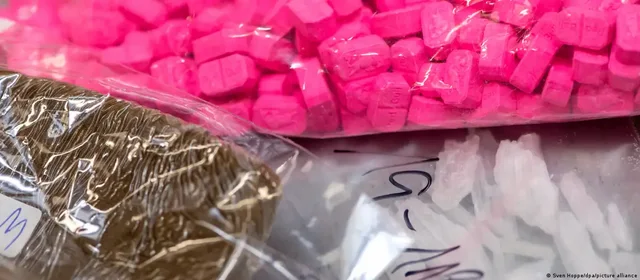
The two girls who died from ecstasy at the end of June in the north of Germany are not a rare case. Every year in Germany, about 1900 people die from drugs, according to the Report of the Federal Office of Criminal Investigation. And the numbers are nearly 9 percent higher than a year ago. Germany thus occupies the first place for drug-related deaths in Europe (total: nearly 6,000 deaths recorded in 2022, according to the European Agency for Monitoring Drugs and Drug Addiction (EMCDDA). Such sudden deaths can be prevented, experts say: First, by raising awareness, but also by giving young people the opportunity to control the composition of the drugs they consume.
Free and anonymous control: One third of overdosed or contaminated substances
Such an opportunity is offered in Berlin. From the beginning of June 2023, drug users in Berlin have the opportunity to test the substances they buy on the black market for free. They can take them to a laboratory, where the ingredients must be analyzed and impurities detected. Within three days they get the result. In Berlin, the demand for drug tests was so high in the first weeks that many tests could not be accepted. Preliminary result: One third of the substances presented are overdosed or contaminated.
"If we had national drug control and if this was widely communicated, perhaps we would have managed to prevent tragic accidents," says toxicologist and drug expert Fabian Pitter Steinmetz.
The Federal Government is opening the legal way for this practice to enter the entire territory of Georgia. The Federal Parliament of Germany has approved the relevant law, but now it must pass to the Chamber of Lands.
What are the most common drugs and how dangerous are they?
Amphetamine and methamphetamine
Synthetically produced amphetamine and its relative methamphetamine – also known as crystal meth – have been in circulation since the late 19th century. These euphoric but non-anesthetic substances were used in medicine until the 1970s. Amphetamine was used as an anti-depressant, appetite suppressant and as an asthma medication. Soldiers used it as a stimulant in combat. Today, amphetamine is used to treat attention deficit hyperactivity disorder (ADHD). Low doses do not damage human brain cells.
But drugs are rife in the techno scene. And there it becomes dangerous, because it is used in higher doses than in medicine. Amphetamine prevents people from relaxing. The consequences are: insomnia, tremors, palpitations - up to a heart attack or stroke.
Addiction potential is average (1.67). If used for a long time or taken in overdose, amphetamine has a toxic effect: there is a risk of organ damage, muscle breakdown and kidney attacks. Since amphetamine is taken through the nose, it can cause the nasal septum to detach. This leads to paranoid delusions, depression, psychosis and even coma.
Methamphetamine (Chrystal Meth) is more dangerous than simple amphetamine. It leads much faster to psychological dependence (addiction potential is 2.39 to 3.0) and addicts need higher and higher doses. People addicted to this drug lose weight faster. The mucous membranes of the mouth and nose decompose and they also lose their teeth.
Sleeping pills
Flunitrazepam, also known as Rohypnol, has exactly the opposite effect. This is why some addicts use it to wind down after a high dose of amphetamine. It is most often recommended as a sleep aid. In combination with alcohol or pain-relieving drugs, a knockout (KO) cocktail is made. Victims who have taken such mixtures will not remember anything later.
Addicts usually use it to replace heroin. Flunitrazepam leads to psychological dependence after only two weeks of use (addiction potential: 1.83). The drug does not always have a sedative effect: it can also provoke states of anxiety, nightmares and hallucinations.
Opium and heroin
Heroin is derived from morphine, the main component of raw opium - i.e. the opioid poppy. Morphine is licensed as a sedative. It can only be used against severe pain, for example in palliative medicine or for acute pain relief in the event of a heart attack.
Unlike morphine, heroin (addiction potential 3.0) is not only anesthetic but also euphoric. It disrupts the natural rhythm of sleep.
Overdosage with two drugs can lead to respiratory arrest and respiratory collapse. This risk is particularly high in addicts who use heroin in combination with alcohol or flunitrazepam.
The toxicity of heroin, as an extremely dangerous drug for addicts, has been overestimated for a long time. In a study done in Bonn, Germany, long-term addicts were treated with heroin under supervision. A control group received methadone, which is a drug substitute (addiction potential: 2.08). Result: The health and social status of heroin patients improved compared to the methadone group. After that, heroin was approved as a curative drug in Germany.
Cocaine and crack cocaine
Cocaine (addiction potential: 2.39) is a substance extracted from the cocaine plant. When the salt extracted from this substance in a drug lab is mixed with sodium bicarbonate, that is, baking soda, and both are heated, crack cocaine is obtained.
Cocaine has a euphoric effect, removes hunger and fatigue. - For a long time, cocaine has been the preferred party drug, or used by performance-oriented men. But cocaine users pay a high price: high heart rate, narrowing of blood vessels, increased blood pressure and the risk of a heart attack.
Disturbances in the sensation of hunger, thirst and hyperactivity can lead to weakening of the body. Long-term use causes paranoid hallucinations up to psychosis, which can be irreversible - ie. incurable. Taking cocaine by mouth destroys the mucous membranes of the mouth, while taking it through the nose destroys the nasal septum.
Especially in the case of crack cocaine, the lethal dose is almost unpredictable because the drug is much stronger than cocaine. In addition, crack cocaine has the highest psychological dependence potential (above 3.0), ahead of heroin, nicotine and alcohol.
LSD
Lysergic acid diethylamide, also called acid, is a synthetic drug that leads to a much stronger perception of the environment. In the 1960s and 70s, LSD was used by hippies to enhance perception and consciousness.
In people with a predisposition to it, LSD can cause irreversible psychosis. The LSD user in these cases "gets stuck on the trip", as it is called in the slang. However, the risk of fatal poisoning is lower than with alcohol or nicotine. The addiction potential of LSD is considered low, at 1.23.
On the other hand, the risk of accidents after taking LSD is very high, since the user under the influence of LSD can do irrational actions, overestimate their abilities, and for example, jump out of the window believing that they are flying. Recently, LSD has begun to be allowed in some countries for the treatment of mental disorders.
Marijuana and hashish
Lawmakers in more and more states are debating legalizing marijuana, whether for medical treatment, as a pain reliever or appetite stimulant, for HIV or cancer, or for recreational use.
The substance tetrahydrocannabiol (THC) in cannabis has a relaxing and anesthetic effect. Addiction potential is rated as "medium" at 1.51.
THC initially affects drug users through an altered, more intense perception of the environment, especially music, taste and sense of time. Typical side effect: cravings for sweet, sour and salty foods.
When used for a long time, it can lead to reduced ability to think and learn, possibly through a change in blood flow to the brain. Particularly dangerous are the carcinogenic toxins that consumers inhale when they smoke. The dangers can be stronger than with pure tobacco smoke, as burning hashish resin produces other cocktails of harmful substances./DW







The trial against former US President Donald Trump will be...

The analyst from Kosovo, Dritëro Arifi, has emphasized tha...

Rritja e çmimeve të drithërave pak pas largimit të Rusisë ...

Një gjykatë federale e ka caktuar gjyqin ndaj ish-presiden...

Sekretari i Përgjithshëm i OKB-së, Antonio Guterres, paraq...
The head of the CIA, William Burns, has stated that the pa...

During a Europol action, the drug baron who coordinated th...

The chief negotiators of Kosovo and Serbia, Besnik Bislimi...

Russian forces attacked the Ukrainian city of Mykolaiv thi...

The Secretary General of NATO, Jens Stolteberg, said on We...

Kiev said on Wednesday that Russia destroyed 60,000 to...

A senior figure in the Ukrainian Orthodox Church has been ...

Women in Afghanistan have held a protest against the Talib...

Defense Secretary Lloyd Austin said a US soldier willingly...

The Kosovo Police has arrested an official of the Agency f...

Russia has raised the age limit for its soldiers as it pre...
Ricardo Martinelli, the former president of Panama, has be...
With French President Emmanuel Macron insisting the Europe...

Proximity to Russia, corruption, illegal wiretapping, poli...

Senior diplomats from Germany, France and Poland ask the p...

CNA has launched another investigation that could lead to ...

Irfan Hysenbelliu is a businessman that we call "Irfan the...

In March 2026, CNA launched another investigation centered...
The arrested mayor of Tirana, Erion Veliaj, with 13 charge...

The Special Board of Appeal (KPA) decided this Monday ...

The KPA vetting decided this Thursday to dismiss the p...

Suela Salavaçi, a prosecutor in the Prosecutor's Offic...

The Special Board of Appeal reinstated the prosecutor ...

Footage emerges from the serious accident that occurred th...

A Shkodra traffic police officer was hit with hard objects...

This Wednesday, around 4:00 PM, a serious accident occurre...

Tirana Police have shared details regarding the accident t...

A serious accident that occurred this Wednesday with the c...

The Institute of Geosciences has shared a forecast for wea...

Rising energy and fertilizer prices are expected to contin...

Over 18,000 foreign citizens from 140 countries have appli...

The trial of ousted Venezuelan President Nicolas Maduro on...

US President Donald Trump has issued another warning to Ir...

Prime Minister Andy Burnham has announced that most bus fa...

France's parliament has passed a law to ban social media f...

At a time when industrial products are increasingly taking...

Trust among people is not just a three-syllable word. It c...

Master of humor Todi Llupi has passed away at the age of 7...

The ninth edition of "MIK Festival" kicked off with one of...

The price of diesel reached 206 lek per liter from 198 lek...

Businesses will no longer be required to simply register t...

Despite economic growth and income in recent years, Albani...

This Wednesday, one US dollar is bought for 81.4 lek and s...