


Euro does not leave the "cliff"/ Exchange rate, August 18, 2024
Today, on August 18, 2024, in the foreign exchange mar...


Despite the overproduction of cherries, processors are buying the fruit as raw material for the production of jam and compote 60% more than in years. The reason is the increase in daily payments for harvesters. The scarcity of raw materials has increased the costs of the processing industry. It is expected that the prices of jam and compote will increase and consumption will decrease. While farmers raise the concern that they are selling cherries below cost.
Mirosh Çela, for 10 years, has planted 1,800 cherry trees on a land area of ??10 hectares, in the village of Slabinje in Mokra, known for the high production of fruit trees, since the communist period.
Due to this year's overproduction in the market, the wholesale price of cherries ranges from 40-60 to 80 ALL. Mirosh Çela says that the price requested by traders is below cost.
"This year, the situation is a disaster. There is overproduction, but we are either selling the cherry below cost, or we are letting it rot on the tree. For a farmer to make a profit from production, he must sell at least 100 ALL per kg of cherries.
From merchants in the area, the requested price of cherries is 60 ALL. Due to the unfair price, 2 tons of produce rotted without selling the trees. I started harvesting 10 tons of produce with the hope of selling it at 80 Lek per kg.
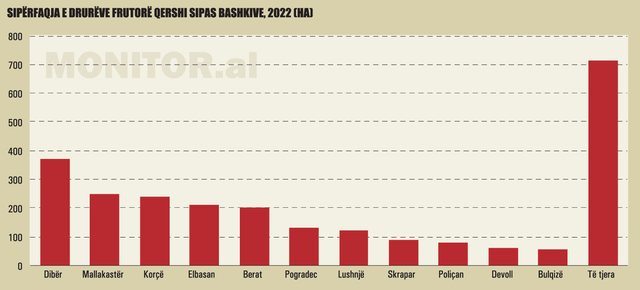
According to INSTAT data, for the year 2022, in the rural areas of the Pogradec Municipality, cherry trees occupied a land area of ??130 ha, or 5% of the total land in the country.
For the farmers of this area, in addition to the lack of a sales market, the main problem of rising costs is the lack of labor. Difficulties in finding harvesters have forced farmers to increase daily payments. He says the payments for them are unaffordable.
"From the sales so far, we are working only for the payments of the harvest workers. I hired 7 workers who we pay 2,000 to 2,500 ALL/day.
So far, I have spent 200,000 ALL for their payments. We also had expenses of over 200,000 Lek for spraying the trees. The costs are unaffordable in the conditions where there is no sales market".
The situation is similar for another young farmer, like Andon Balliu, who has planted 600 cherry trees for 4 years. "This year the production was good, but the cherries are left unharvested on the trees.
It is not useful for me to sell the production at the requested price of 40 or 60 lek. Cherries should be sold for at least 100 ALL per kg so that we can make a profit", he asserts.
In the area of ??Korça, according to agronomist Nevion Telha, the cherry was sold almost to the extent of 70-80%, but at a price below cost.
"Initially, cherries were sold at 150 ALL per kg, but then the price was reduced to 70 ALL per kg. Compared to years, the price is the same. One year the cherry rotted, due to weather conditions, and there was not much production.
This year there is production, but the increase in the cost to farmers due to the increase in payments to harvesters remains a problem. Last year the payments were 1,500 ALL per day, while this year they have reached 2,000 to 2,500 ALL per day. Otherwise, no one comes to work", said Mr. The wire.
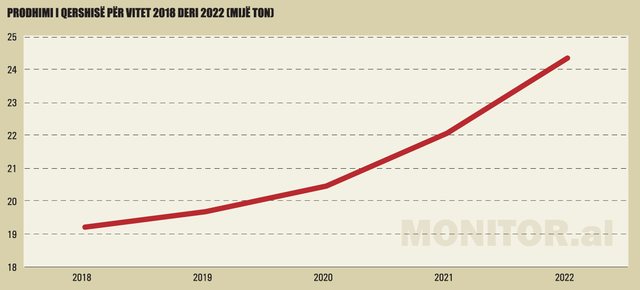
Cherry production according to INSTAT data for 2022 increased by 11% compared to 2021. Last year, according to farmers, cherry production was low compared to the previous year, due to unfavorable climatic conditions.
In 2022, at the country level, cherry fruit tree crops reached a land area of ??2,525 ha. Compared to 2021, the area of ??crops increased by about 1%.
The municipality with the highest area of ??land planted with cherries is that of Dibra, which occupies 15% of the total.
Next is the Municipality of Mallakastra with 10% of the total land area, the Municipality of Korça with 9.5%, that of Elbasan with 8.3%, crops in Berat occupy 8% and in Pogradec, 5%.
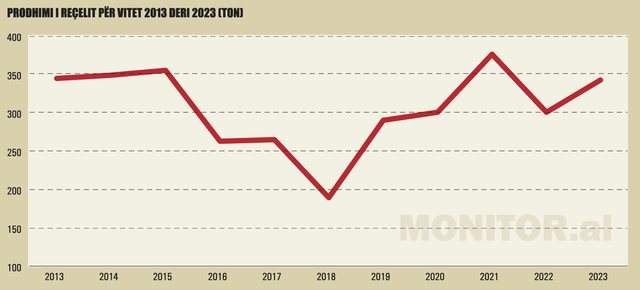
For the year 2023, a total of 343 tons of jam were produced. The production of jam years, according to the data of the Ministry of Agriculture, increased by 14% compared to 2022.
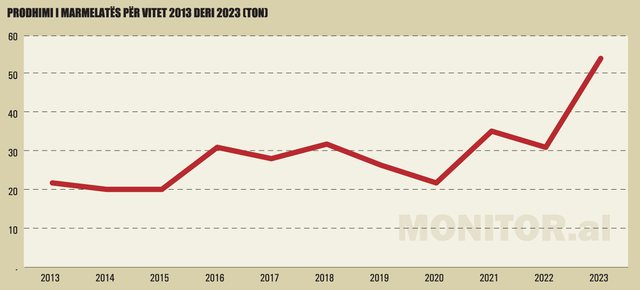
There was also an increase in production for marmalade. For the year 2023, the amount produced reached 54 tons.
This is the highest amount of marmalade production in the last 10 years, namely for the period from 2013 to 2023. Compared to 2022, the annual production has increased by 74%.
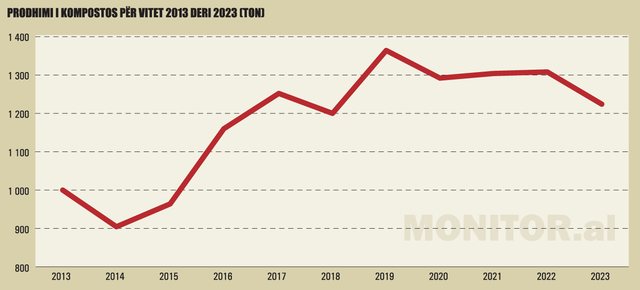
While the production of compost for 2023 has declined. According to the data of the Ministry of Agriculture, 1,223 tons of compost were produced last year. The quantity produced is 7% less than in 2022.
This year there is an overproduction of cherries, even of good quality, according to agronomist Vevion Telha, but farmers are selling the production below cost.
Farmers said that the first quality is sold for fresh consumption at a good price from 150 to 200 Lek per kg. While the second quality that coincides with a large quantity goes for processing at a price below the cost of 60, 70, 80 or 90 ALL.
For fruit processors who have started the production of jams and compotes since the beginning of June, the price of cherries purchased as raw material, on average, this year is up to 60% more expensive than last year, due to the increase in payments to the harvesters.
"Cherry production is full this year, in all areas, such as in Korça, Dibër, Elbasan, etc. But the selling price of cherries has increased because there is a lack of labor to pick cherries and other fruits.
The average selling price for years was 50 to 60 Lek, which did not have high production.
This year the average selling price is 80 ALL per kg. It is expensive for the processing industry, when the price of sugar and packaging materials is high", said the representative of one of the processing factories in Berat.
The two main fruit processing factories for jam and compote, "Sidnej" in Berat and "Zdrava" in Lushnje, each process 10 to 15 tons of cherries per day.
The raw material for cherry jam from the company "Zdrava" is being provided at a price of 85 to 95 ALL per kg. The company processes only Class A cherries of the Napoleon variety for jam and compote.
Sajmir Sinanaj, the technologist of the processing factory, told "Monitor" that the production season of cherry jam, compote or marmalade is expected to last up to 25 days.
Mr. Sinanaj claims that this year, the production is good, but the price of the raw material, which is mainly provided by the farmers of Dibra, Korça and Berat, is higher than last year. Despite the increase in the price of the raw material, he says, the cost will not change. This is because the selling price of sugar has been reduced.
Even the Chairman of the Agribusiness Council, Mr. Agim Rrapaj, says that the price of cherries is higher than last year due to the increase in wages for the workforce.
"The lack of labor force has caused the production not to be finished at the right time, significantly losing the quality of raw materials, increasing the scarcity, as well as increasing the losses", underlines Mr. Rape.
Years for managers of jam and compost factories, the situation of tree production turned out to be alarming, affected by unsuitable climatic conditions.
The lack of production in fruit trees led to some processors reducing the production of jams, compotes and marmalade by up to 50% compared to 2022.
The main reason for the halving of production was the lack of fruit. Not finding the raw material penalized the industry even for export contracts, as foreign entrepreneurs demand high quantities of products that cannot be guaranteed.
Alban Çakalli, a farmer from Mamurrasi, with extensive knowledge in the field of agriculture, analyzes that the main reason for the lack of finding employees for fruit harvesting is the short season in the country, which does not bring much income.
It is different in the countries of the region and Europe, which guarantee the harvesters 6 months of work and with high payments.
"In the villages where they are focused on the cultivation of fruits, there is no diversity of cultivars so that the production can be extended in time. Often they all have the same cultivar ripening at the same time and don't get to make the entire harvest.
For example, cherries ripen for two weeks. In other countries, there is a two-month time frame. Thus, the workers also look with interest to go to the villages where they are guaranteed two months of work".
On the other hand, according to him, other countries pay the workers with the kg they harvest. Here on weekdays. "Workers are encouraged to gain more in kg. You are offered accommodation and food in other places.
There are also working groups that give yield in the harvest. It would be good to cultivate other crops, so that the work in harvesting the fruits lasts more than three months.
In Spain, cherry picking is combined with peaches, grapes and figs. More than 6 months of work is provided. Then, after 6 months of work, he goes to the assistance for another 6 months.
And so the workers do not leave the village. This is called sustainable agriculture, which greatly affects the agricultural economy. We are very far from these policies", asserts Mr. Jackal.
At least the cherry jam or compote, which started to be produced first with the beginning of the fruit processing season, the main factories expect to increase compared to years.
But some of them, due to the high cost of production, are expected to come out with a more expensive selling price.
One of the representatives of the processing factory in Berat said that compared to years, it expects to produce 20% more cherry jam and compote.
He says that the selling prices are expected to be higher, due to the raw material being bought more expensively, but also the additional costs that the processors themselves have from the wages of the workers in the factory.
Agim Rrapaj, from the Albanian Agribusiness Council, says that the production costs are higher, since in addition to the impact of the labor force, there is also the high price of packaging, electricity and fuels.
The jam production process goes through several stages, starting with washing the fruit, removing seeds and stems in the case of cherry jam production, and up to boiling and packaging.
In the "Zdrava" company, the entire production process is automated, thanks to an investment made in 2019 in the amount of 2.5 million euros through grants given by the IPARD program, which has helped to reduce the cost of the workshop.
"The automation of the production line has greatly reduced the cost of maintaining a high workforce", affirms Sajmir Sinanaj, the technologist of the "Zdrava" fruit and vegetable processing factory.
"This year, processing costs are expected to be cheaper than last year, as the prices of some raw materials, such as sugar, have decreased from 100 Lek per kg that was purchased last year, to 70 Lek per kg in 2024.
There was also a drop in prices for packaging materials.
Therefore, the sales prices are not expected to increase".
For some of the processors, the increase in the flow of foreign tourists is expected to boost the consumption of jams this year in the main trading chain in the HoReCa (Hotel-Restaurant and Catering) sector.
Last year, the company "Zdrava" sold 350 tons of jam and cherry concentrate according to Mr. Sinai. This year, sales are expected to reach 500 to 550 tons, or about 57% more.
About 25% of the company's production of all types of jam is exported to several countries, such as: Kosovo, Serbia, North Macedonia, Bosnia-Herzegovina, Sweden, Finland, Germany and Belgium.
The rest is sold in the hotel chain, for about 450 hotels in the country. With the increase in the number of tourists, the demand for all types of jams from accommodation structures is expected to increase.
Agim Rrapaj from KASH says that sales of jams this year are expected to increase compared to last year, as a result of the greater flow of tourists.
While other producers claim that the increase in selling prices will reduce purchasing power.
"The rise in prices is expected to reduce consumption. On the other hand, purchases from pastry shops and consumers have also fallen due to emigration", claims one of the representatives of the processing factories.
They recommend that in order to improve these products, it is very important that in state institutions, such as prisons, kindergartens or hospitals, the priority remains the use of Albanian products and not imported ones.
Processors raise the concern that the reference prices of the purchase of these products in the tender are too low, compared to the cost of production.
In many cases, such as in prisons, due to cost effectiveness, chocolate cream is tendered rather than locally produced jam.
In 2023, the decline in the supply of domestic raw material significantly increased the price of fruits used by processing industries. The increase in prices also made costs more expensive.
There was more tightening of the price for the "Tropojane" plum variety, the most used by the processing agro-industry for the production of jam.
From 30 to 50 Lek per kg in 2022, it was traded from 80 to 100 Lek per kg in 2023. The increase varied from 100% to 1.6 times more. There was also an increase in the selling price of peaches by about 50%. Last year, the price of peaches for processing was 60 to 70 ALL per kg.
The season for processing plum jam and compote starts in July, to continue with peaches and figs.
Processors expect expensive prices compared to years even for these fruits that they use mostly for the production of jam and compote.
Alban Çakalli says that the increase in demand, influenced by tourism, will increase the selling prices of fresh fruit.
"We often import plums. We also imported figs for fresh consumption. There are large quantities of apples, but no effort is made to increase the visual quality.
Last year, figs were sold at 200 ALL per kg wholesale. In the markets there were also figs imported from Greece. If we have the same trend of tourism as years, I believe that the prices of fruits will increase.
A good solution is to program the planting depending on the consumption".
The recovery of the processing industry, compared to the high decline that the production of jams and compotes had for years, has increased the import of sugars.
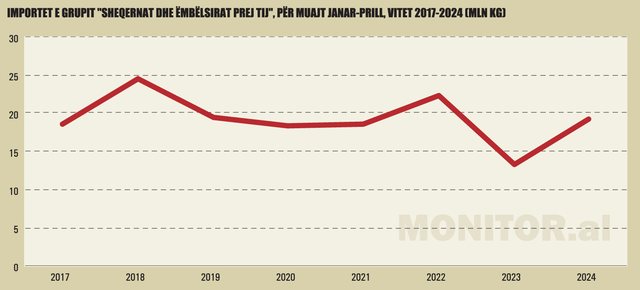
According to INSTAT data, imports of the "Sugars and sweets from him" group, in the months of January-April 2024, increased by 46% compared to the previous year.
Last year, in the period January-August 2023, sugar imports recorded the lowest amount in the last 7 years. According to Customs data, in that period imports fell by 33% compared to the same period in 2022.
Wholesalers claimed earlier that the causes of the drop in imports were the decline in consumption from immigration and the demand for sugar from the jam production industry.
The agro-industry of the production of jams, compotes and marmalade in 2023 suffered from the lack of finding the raw material of fruits. For this reason, factory managers said they produced 50% less than last year.
For agronomists, the reason for the decline in tree production in the country was the high humidity in the spring./ Monitor.al

Today, on August 18, 2024, in the foreign exchange mar...

The second quarter of the year was characterized by a slig...

The lack of rainfall and the increase in electricity c...

The coordinator for the Economic Program in DP, Dorian...
Salaries in the private sector have increased by 12.7%...

The influx of foreign tourists has boosted the number of d...

Unsustainable development on the coast, where the high pac...

Today, on August 17, 2024, in the foreign exchange mar...

South Korea has returned to the second place from wher...

Today, on August 16, 2024, in the foreign exchange mar...
Internal inflationary pressures are slowing down, but stil...

An international feasibility study has confirmed the econo...

High salaries in the tourism industry are attracting m...

Today, on August 15, 2024, in the foreign exchange mar...
Contrary to what was expected for the month of August, con...

Today, on August 14, 2024, in the foreign exchange mar...

The exchange rate of the euro fell below the limit of ...

Today, on August 13, 2024, in the foreign exchange mar...
The summer season in Durrës is turning out to be weaker th...

60% of families in Albania can have enough liquidity t...

CNA has launched another investigation that could lead to ...

Irfan Hysenbelliu is a businessman that we call "Irfan the...

In March 2026, CNA launched another investigation centered...
The arrested mayor of Tirana, Erion Veliaj, with 13 charge...

The Special Board of Appeal (KPA) decided this Monday ...

The KPA vetting decided this Thursday to dismiss the p...

Suela Salavaçi, a prosecutor in the Prosecutor's Offic...

The Special Board of Appeal reinstated the prosecutor ...

A road accident occurred this evening on Nikolla Zoraqi St...

Three people were shot and wounded in Elbasan last night b...

A serious incident occurred this Tuesday in the Yrshek are...

An accident occurred this Tuesday on "Dituria" street in K...

All of Southern Europe will face changing weather conditio...

Albania was hit by temperatures significantly higher than ...

For the first time, Pogradec welcomed the Inter-Lake Chess...

Albania has achieved a record for the employment of foreig...

US Secretary of State Marco Rubio arrived in Manila on Jul...

In the space of a few days, Ukrainian President Volodymyr ...

The spokesman for the Iranian Foreign Ministry warned Bulg...
Autoritetet italiane sekuestruan pako me afër 800 kilogram...

At a time when industrial products are increasingly taking...

Trust among people is not just a three-syllable word. It c...

Master of humor Todi Llupi has passed away at the age of 7...

The ninth edition of "MIK Festival" kicked off with one of...

Construction company licenses will have a validity period ...

The Centralized Purchasing Operator recently opened a tend...

The new draft law "On the Bank of Albania" provides that t...

This Tuesday, one US dollar is bought for 81.2 lek and sol...