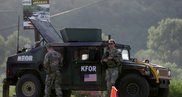


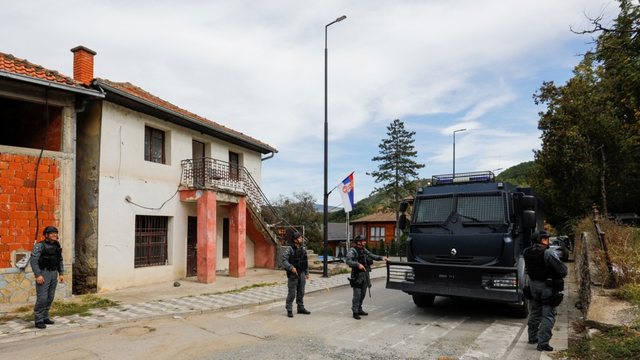
On September 24, Kosovo woke up to the news that a member of the police was killed and at least two others were injured during clashes with an armed group in the north inhabited by a majority of Serbs. Three members of the group were killed during clashes that lasted almost the entire day, raising concerns about stability in the fragile region.
The police said they found a significant amount of weapons in the area of ??the Orthodox monastery in the village of Banjské, where the attackers were hiding.
"One heavy armored vehicle, 24 jeeps, 2 4x4 motorbikes, 8 anti-personnel mines, 29 packed clods, 54 82mm mortar rounds, 88 62mm mortar rounds, 75 hand grenades, anti-tank mines 8 pieces, 150 pieces of dynamite explosives, 23 pieces of electric detonators," said Kosovo Police Director Gazmend Hoxha.
Kosovo accused Serbia of organizing and supporting the group. Belgrade denied involvement in the attack, saying the group was made up of Kosovo Serb citizens revolted by Pristina's approach.
But the American ambassador in Kosovo, Jeff Hovenier, said that the group was organized.
"We are still working to understand how and who is responsible and why. But I mean, you've seen the footage of the military equipment and the plans that were developed. This was not a group of citizens who spontaneously came together to voice their concerns. This was a trained and organized group. This implies that there is some sort of structure behind them, given the training and equipment. We want this incident to be brought to light and they are held accountable," said Ambassador Hovenier.
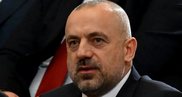
On September 29, Milan Radoicic, former vice president of Lista Serbe, the largest party of Kosovo Serbs supported by Belgrade, took responsibility for the preparation and leadership of the armed group.
The United States and the European Union expressed concern over what they described as "an increased Serbian military build-up on the border with Kosovo", while asking Belgrade to urgently withdraw its troops. Kosovo also accused Serbia of gathering along its border.
Serbia denied having increased its forces on the border, but later admitted that there were reductions in the military presence near Kosovo.
The attack was widely condemned by local and international institutions that called for the perpetrators to be brought to justice.
NATO approved additional forces in the field which reached about 1 thousand, the biggest reinforcement of KFOR since the declaration of Kosovo's independence. NATO Secretary General Jens Stoltenberg said the alliance would consider increasing its long-term presence in the region.
The September 24 attack followed a period of tension in the Serb-majority north of Kosovo. More than 90 members of the peacekeeping forces were injured on May 29 in a clash with groups of Serbian protesters who opposed the implementation of the results of local elections in the area boycotted by Serbian political parties.
The violence erupted after Kosovo authorities escorted the mayors to their offices with police forces, despite Western calls to avoid such action.
The American ambassador in Pristina, Jeff Hovenier, said that the government of Kosovo has not coordinated with the United States on the developments in the north and has created an unnecessary crisis, also damaging relations with Washington. The United States canceled Kosovo's participation in the "Defender Europe 2023" exercises.

US Secretary of State Antony Blinken said that "Prime Minister Kurti and his government should take measures for elected mayors to carry out their duties of this transitional phase in alternative settings, not in municipal buildings, and withdraw the forces police around them".
However, Prime Minister Kurti said that he will not remove the mayors of the municipalities and will not hand over the Republic to a fascist gang, as he said.
"What I am doing is my duty. There are parallel structures in the northern part of our country. If I now order the mayors to leave those offices and go to an office somewhere else, it would be as if I am committing to creating a kind of parallel structure with parallel structures, copying the method of the Serb leaders. of Kosovo. I would join their illegality. I cannot do this", said Prime Minister Kurti.
Belgrade raised the level of military alertness and ordered troops to be deployed near the border with Kosovo, prompting new security concerns in the region.
Tensions increased after three members of the Kosovo police were arrested by Serbian forces who claimed that they had entered the territory of Serbia. " hers.
The three policemen were released after a few days following pressure from the United States of America and the European Union on Belgrade.
The European Union sought to reduce tensions through a plan that provided for the suspension of police operations in the north, the relocation of mayors to alternative offices and the announcement of early elections with the unconditional participation of Kosovo Serbs.
In the middle of June, the European Union announced restrictive measures in Kosovo, due to the government's failure to take steps to reduce tensions in the north.
In July, the Kosovo government said it had agreed to reduce the presence of police forces in the north and support the holding of new elections. The agreement was reached in Bratislava in a meeting between the Deputy Prime Minister of Kosovo, Besnik Bislimi and the special envoy of the European Union, Miroslav Lajçak.
"Both parties must have the opportunity to negotiate from equal positions, which has been compromised by the imposition of temporary measures against Kosovo by the European Union. In conclusion, I believe that the agreement of Bratislava will help a lot in strengthening the concentration and establishing equality between the parties, which helps the full implementation of the basic agreement", said Prime Minister Kurti.
Western punitive measures fueled concerns in Kosovo, especially regarding relations with Washington after Kosovo's exclusion from the Defender Europe 2023 exercises.
"This is not good for us, of course, we admit that it is a bad thing for the Republic of Kosovo. All we have to do is to have an open dialogue with all our friends and partners, so that we can argue our positions better. Maybe our positions are not being understood correctly by the United States", said the Speaker of the Parliament of Kosovo, Glauk Konjufca.
The opposition expressed concern with the American sanctions and blamed Prime Minister Albin Kurti for lack of coordination with Kosovo's main ally.
"(Albin) Kurti has decided to protect Kosovo from America, we have decided to protect Kosovo from the damage that (Albin) Kurti is causing to Kosovo's national interests. (Albin) Kurti has decided to fight against our allies for political purposes, for a few votes or more, we have decided to fight together with our allies for the Republic of Kosovo, and this war requires diplomatic prudence, coordination with international friends and insistence on defense of the interests of Kosovo. However, one of the vital interests for Kosovo has been and remains friendship with the United States of America and the European Union. Kosovo cannot be defended when this interest is violated", said the chairman of the Democratic League of Kosovo, Lumir Abdixhiku.
"This is harmful, unacceptable and in the face of this situation we cannot sit idly by and must take responsibility in our own hands in order to be able to repair the damage caused by this government and Prime Minister (Albin) Kurti". said the head of the parliamentary group of the Democratic League of Kosovo, Abelard Tahiri.
The Chairman of the Alliance for the Future of Kosovo, Ramush Haradinaj requested the beginning of the procedures of a motion of no confidence in the government of Prime Minister Albin Kurti.
"The motion of no confidence is based on the two most recent developments. The first is the jeopardizing of sovereignty and security in the north and the second is the breakdown of relations with the United States of America and the European Union up to the sanctions from the USA against Kosovo", said Mr. Haradinaj.
Under Western pressure, the Kosovo government withdrew some police officers from municipal buildings and drafted a document that would allow citizens of northern municipalities to dismiss their mayors through a petition.
But by the end of the year neither the elections were held nor the measures were lifted.
The September 24 attack is considered the worst event since Kosovo declared its independence in February 2008. Concerned about the security situation, Western diplomacy tried to renew the process of normalizing Kosovo-Serbia relations in based on an agreement that was reached in February in Brussels and the ways of implementation of which the parties agreed in Ohrid in March.
On February 27, the head of foreign policy of the European Union, Josep Borrell, who mediated a meeting between the Prime Minister of Kosovo, Albin Kurti, and the President of Serbia, Aleksandar Vucic, said that both leaders showed responsible behavior and willingness to find solutions based on of a plan which became known as the Franco-German initiative.
"I am happy to announce that President Vucic and Prime Minister Kurti have agreed today that there is no need for further discussions on the European Union's proposal. A proposal entitled "agreement on the path to normalization of relations between Kosovo and Serbia", said Mr. Borrell.
On March 18 in Ohrid, Mr. Borrell mediated a 12-hour meeting about the implementation of the agreement, which he said will be part of the integration process of both parties in the European Union.
"I want to emphasize that in order to pave the way towards achieving the strategic goal of membership in the European Union, Serbia and Kosovo must normalize relations between them. There is no other way out. And this agreement, this annex that is an integral part of the agreement, is an important step forward to make it a reality," said Mr. Borrell.
The agreement requires good neighborly relations, recognition of documents and symbols, and respect for each other's sovereignty and territorial integrity. It requires that the parties do not hinder each other in the integration processes, but does not require mutual recognition. The plan also envisages the fulfillment of all agreements previously reached in talks mediated by the European Union.
The agreement was welcomed by Western diplomacy and there was a degree of optimism that its implementation will begin immediately. However, this did not happen and the parties went through periods of high tensions.
On October 21, the American and European envoys delivered to the parties a document for the implementation of the agreement, part of which was also a proposal for the statute of the Association of municipalities with a Serbian majority", which is also the most difficult point of the negotiation process Kosovo - Serbia.
On October 26, the leaders of Kosovo and Serbia met with the leaders of the main countries of the European Union, French President Emmanuel Macron, German Chancellor Olaf Scholz and Italian Prime Minister Giorgia Meloni, as part of Western efforts to advance the implementation of the Ohrid Agreement.
The Prime Minister of Kosovo, Albin Kurti, said that he was ready to sign the project offered by Western diplomacy for the establishment of the Association, accusing Serbian President Aleksandar Vucic of rejecting it.
The Serbian president said that the issue of signing or not signing was not raised during the talks, while he described the October 21 proposal as a good basis for continuing discussions in the future.
On October 27, French President Emmanuel Macron, German Chancellor Olaf Scholz and Italian Prime Minister Giorgia Meloni in a joint statement asked Kosovo to start the procedure for the establishment of the Association of Municipalities with a Serbian majority, while Serbia to recognize the de-facto citizenship of Kosovo.
The content of the draft statute of the Association provoked many debates, especially due to the fact that it was kept under a veil of secrecy for a while.
Serbia said it will not implement the parts of the Ohrid agreement that lead to the de facto or de jure recognition of Kosovo.
On April 3, at the Special Court of Kosovo with headquarters in The Hague, the judicial process began against the former president of Kosovo Hashim Thaçi and three other former officials of Kosovo, under charges of war crimes and crimes against humanity.
Mr. Thaçi, Jakup Krasniqi, Kadri Veseli and Rexhep Selimi, senior leaders of the Kosovo Liberation Army, are accused of persecution, imprisonment, other inhumane acts, torture, murder and forced disappearance of persons.
The Special Prosecutor's Office says that the alleged crimes were committed in the period from March 1998 to September 1999 and occurred in several areas throughout Kosovo, as well as in Kukës and Cahan, in Northern Albania.
According to the prosecution, the crimes are suspected to have been committed by members of the Kosovo Liberation Army against hundreds of civilians who were not involved in the fighting. The prosecution claims that the victims, around 100, are mostly Albanians, but there are also Serbs and Roma from Kosovo.
All the accused denied the allegations of the prosecution.
The Special Court was established in 2015 by the parliament of Kosovo and operates based on its laws, but with international personnel. The idea for its establishment followed the investigations of the claims of the envoy of the Council of Europe Dick Marty, whose report presented to the Council of Europe in 2011, contains accusations against former members of the Kosovo Liberation Army for kidnapping, ill-treatment, murder without trial and in some cases forceful removal of human organs and their trafficking from Albania during and after the war in Kosovo.
But this issue has not been included in any of the charges so far.
"The international community said that a special court was essential to lift the black cloud on the allegations of organ trafficking. The world now knows, today as a result of this process, that there was no organ trafficking and the yellow house never existed. We now know that we have been exonerated of these charges. The truth has been told and the black cloud has been lifted. This sacrifice was worth it", said Mr. Thaçi at the beginning of the judicial process.
Until now, the Special Court sentenced the former member of the Kosovo Liberation Army, Sali Mustafa, to 22 years in prison. Currently, the trial against the former member of this army, Pjeter Shala, is ongoing.
All of them have denied the accusations, which have provoked reactions in Kosovo, where it is claimed that in this way reconciliation is being made with the atrocities committed by the Serbian forces during the war of 1998-1999.
While Kosovo was marking the 16-day campaign against violence against women with the motto "United against violence...", the country was shocked by the announcement of the murder of a 30-year-old woman.
Three people were arrested in connection with the murder, among them her husband suspected of organizing the murder, which sparked large-scale reactions and protests with demands for more safety for women and maximum punishment for perpetrators of violence against them.
"Today we have gathered here to say stop to femicide, to say stop to the killing of women and their oppression. Today we demand justice for Liridona and for all the murdered girls and women, we demand maximum punishment for the criminals according to the law", said Nertila Qarri Gërguri from the organization "Artpolis".
"And we are closing a year weighed down by the shadow of sadness because we unjustly and violently lost the sacred lives of our beloved fellow citizens. Liridona Ademaj is the name that rings loudly, like the name of many other women and girls, as a daily reminder of the searing pain that is left behind when injustice takes place strongly", said the President of Kosovo Vjosa Osmani in her annual speech to the parliament.
According to data from the Kosovo police, four women were killed in 2023, while from January to October, two thousand and 100 cases of domestic violence were reported. The most frequent cases were violence against women.
Statistics say that since the end of the war, 66 women have been killed by their husbands./ VOA

Në Spitalin Universitar të Janinës po trajtohet në gje...
French authorities have warned that there will be terr...
The Republican Election Commission (RKZ) announced on Dece...
A senior delegation of Hamas officials was expected to tra...
An unidentified aerial object has entered Polish airsp...

The three people accused of murdering Liridona Ademaj ...
Ligjet liberale për larjen e parave, marrja lehtë e në...
Russia has launched a wave of attacks on several cities ac...

Data released by the US Census Bureau on Thursday said...
Republican presidential candidate Nikki Haley was aske...

The drug supply system in the United States, from producti...
Ukraine and Hungary are preparing to hold a meeting betwee...
After the publication of the first results of the general ...
Broadcasting authority RTUK decided on Thursday to ban the...
Mexican and US officials agreed to keep border crossings o...
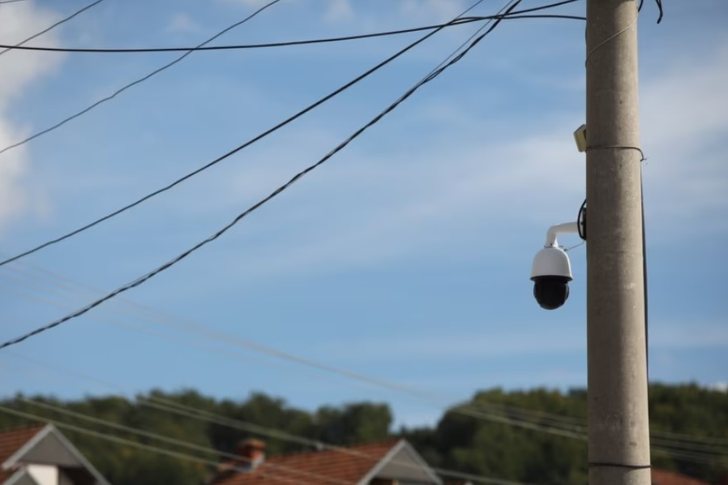
In Kosovo's Serb-majority municipalities, the police began...
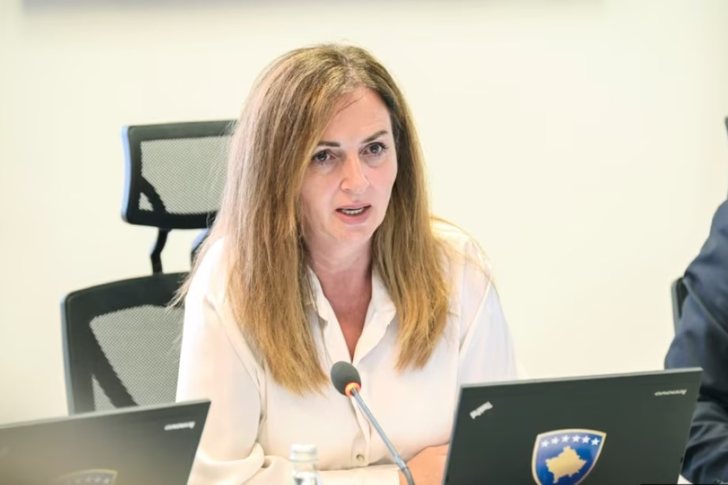
The Minister of Education, Science, Technology and Inf...
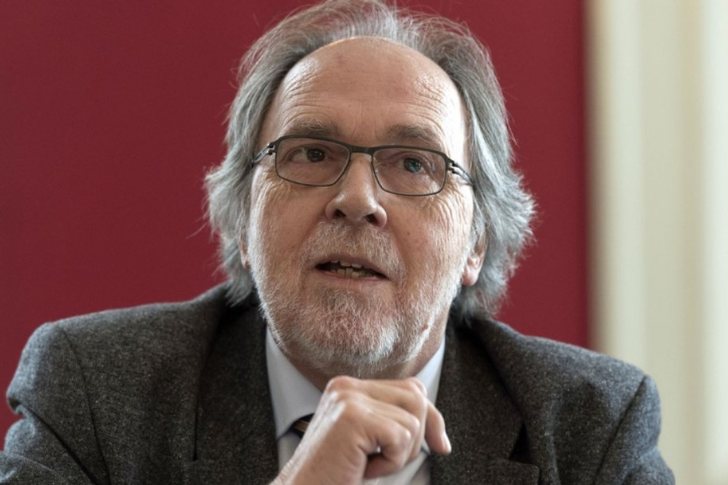
The former rapporteur at the Council of Europe, Dick Marty...
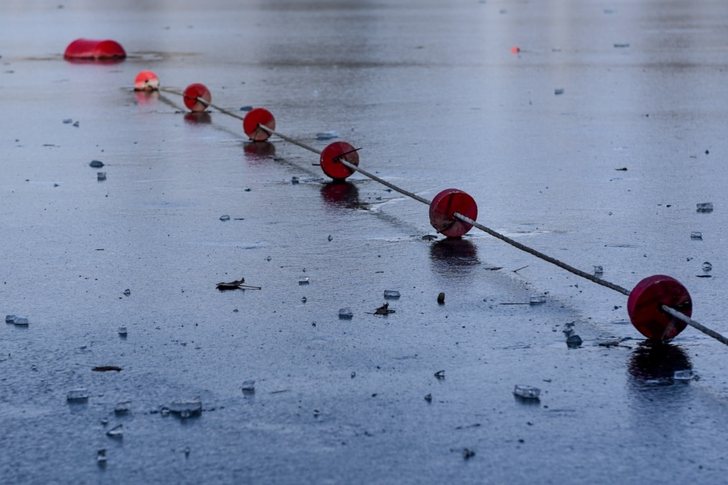
A plane with 34 passengers has landed on a frozen lake in ...
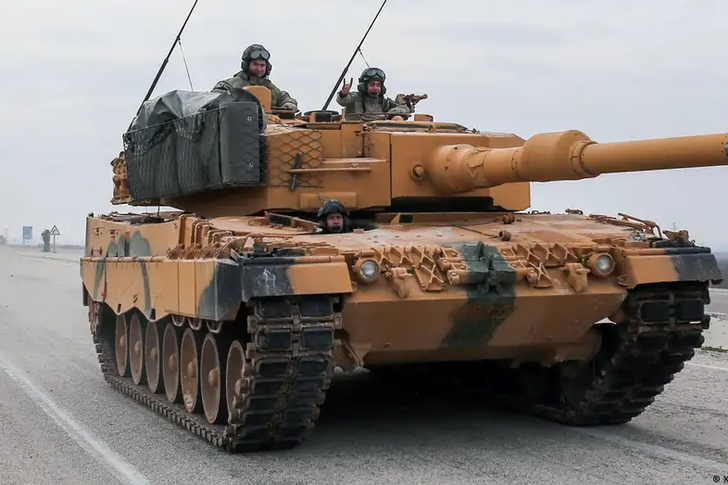
The German government approved the export of arms and ...
A 39-year-old citizen has been arrested in Lezha, after se...

CNA has launched another investigation that could lead to ...

Irfan Hysenbelliu is a businessman that we call "Irfan the...

In March 2026, CNA launched another investigation centered...

The Special Board of Appeal (KPA) decided this Monday ...

The KPA vetting decided this Thursday to dismiss the p...

Suela Salavaçi, a prosecutor in the Prosecutor's Offic...

The Special Board of Appeal reinstated the prosecutor ...

An accident involving three vehicles occurred a few minute...

55-year-old Belere Plaka, who was injured today with a sho...
Police Announcement: Following preliminary information...
New details from the operation being carried out in Fier t...

By noon, cloudiness is expected to prevail in almost all o...

Children without parental care, for whom alternative famil...

On Thursday, our country will be under the influence of st...

A serious accident that occurred this Wednesday with the c...

United States President Donald Trump has left open the pos...
Israeli Prime Minister Benjamin Netanyahu will travel to t...
A bipartisan group of US lawmakers is calling for a Europe...
US President Donald Trump will host his Ukrainian counterp...
In my research at the Central State Archives, specifically...

At a time when industrial products are increasingly taking...

Trust among people is not just a three-syllable word. It c...

Master of humor Todi Llupi has passed away at the age of 7...

War, weather and supply disruptions could send gas prices ...
The number of active enterprises in Albania continued to g...
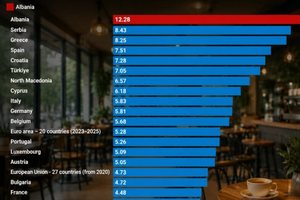
In Albania, the bar-cafe has long become an almost unique ...

This Friday, one US dollar is bought for 81.7 lek and sold...