


Veliaj's gross mistake/ Concrete mixers "invade" the streets of Tirana
The problem with the circulation of heavy vehicles on the ...

The problem with the circulation of heavy vehicles on the ...

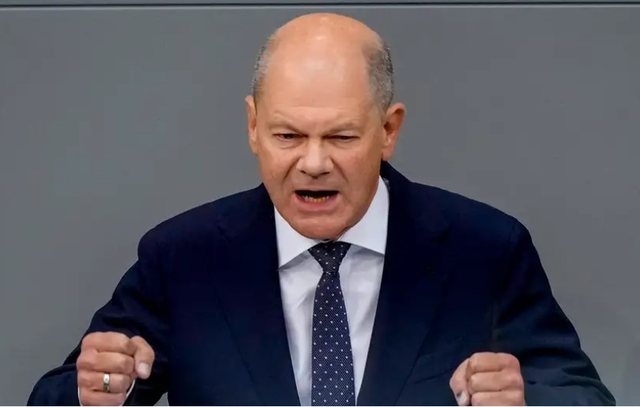
Olaf Scholz is a calm man who is hard to make angry. Can he get out of control, raise his voice or be emotional? It happens very rarely, that the social democratic chancellor deviates from his calm, professional and reasonable line.
His presentation in the Bundestag (11.09.2024) during the so-called general debate was completely different. This debate always takes place during the week of the budget discussion, when parliament meets to consult on the next year's budget. The government and the opposition use this session for general debates also related to the work of the government.
The balance from the opposition's point of view, as expected, was miserable. "Is Germany safer today than in 2021? No. Is Germany more competitive today than in 2021? No. Is Germany more politically stable today than in 2021? No." This is how Alexander Dobrindt, the chairman of the parliamentary group of the Bavarian conservatives of the Christian Social Party (CSU), opened the debate. "The coalition is not a coalition of progress, but of the destruction of this country."
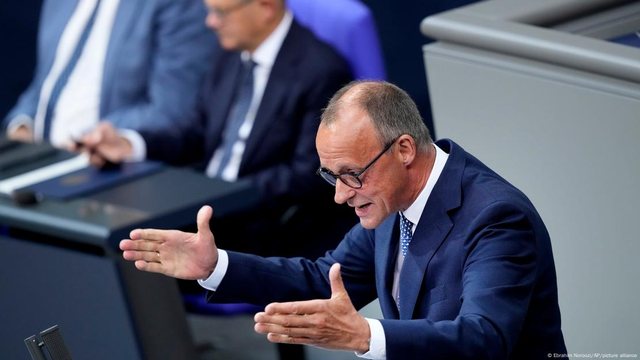
The central topic of the debate was the policy of the Diaspora and refugees. After the failure of migration talks between the government and the Christian Democrats/Christian Socials (CDU and CSU) in opposition, the chancellor and CDU chairman Friedrich Merz exchanged strong words, verbally attacking each other. They mutually hold each other responsible for the failure of efforts to jointly find a solution to the problem of irregular migration.
After the knife attack in Solingen in mid-August, the government presented proposals to tighten migration and security laws. In essence, it is intended that already at the border, accelerated processes for asylum applications will be carried out. Refugees who are rejected must be held near the border until their asylum application is processed.
These plans are "too far from what is necessary," Merz criticized in the Bundestag. The CDU/CSU wants the refugees to return from the border, because Germany is currently overloaded with their acceptance and integration. People must apply for asylum, according to the Dublin Regulation, in the country where they first crossed the EU border.
Merz repeated in the Bundestag clearly: "In our opinion, the return of refugees to the state borders of Germany is and remains legally permissible, against the background of the current situation, this is practically possible and even politically necessary."
But the government, referring to European laws, rejects this. "Some of you are now quite surprised that the neighboring countries are still where they are, and they tell us that we do not accept this," said the outraged chancellor, addressing the parliamentary group of conservatives. "Since there are so many women and men with great hubris, I tell you expressly: The power of the Federal Republic of Germany ends at the borders of the Federal Republic of Germany."
Scholz doubted that the conservative union really took cooperation seriously. He called it a "theatrical show" and a lack of will to really solve the migration problem. The conservative union from the beginning did not aim to reach an agreement and then "disappeared".
Addressing Merz, Scholz shouted: "You are the type of politician who believes, in an interview with the newspaper 'Bild am Sonntag', that he has solved the issue of migration. But before he gets out of the newsroom well, he forgets what he proposed , because you never planned to take care of it."

They were unusual personal attacks, the tone of the speeches was partly exasperated. Merz was more outraged by the accusation that the union has aimed for the failure of the migration talks from the beginning. This assumption, that the talks "were a sham", is "infamous", said the head of the CDU.
He also rejected the accusation that the union is xenophobic. "Germany must be and remain an open and friendly country towards foreigners." The Union is "totally and unequivocally against all forms of xenophobia and xenophobia".
During his speech, Merz further criticized the government's policy. An "overwhelming majority of the citizens of the federation" no longer trusts the SPD, the Greens and the FDP, "that they are bringing the country on the right course", the head of the CDU summed up the mood in the country. According to current polls, three quarters of Germans are dissatisfied with the work of the government.
The elections in Saxony and Thuringia were a disaster for the government coalition parties. The partly far-right AfD has won twice as many votes as the SPD, the Environmentalists and the FDP combined. On September 22nd are the parliamentary elections in the state of Brandenburg. AfD leads there as well.
Changes in asylum and migration policy are demanded by a majority of citizens. Chancellor Scholz made it clear in the Bundestag that he is open to cooperation with the conservative union. "Leading does not mean climbing the barricades making wild gestures," he said to Merz. "Management means, to put your people in motion for a compromise."/ DW


This Thursday, the former president of Peru, Alberto F...

A former CIA employee and FBI language contractor who rece...

About 67.1 million people watched the presidential deb...

In the United States, about 3,000 victims of the terrorist...

Democratic Vice President Kamala Harris and former Republi...

At least 34 people have been killed, including 19 women an...
France will have a new Government "next week", said the re...

United States President Joe Biden said late Tuesday th...

September 11, 2001 will long be remembered in people's min...

The United Nations Organization (UN), in the new proje...

Former President Donald Trump and Vice President Kamala Ha...

Germany has insisted that its decision to carry out border...
The Prime Minister of Kosovo, Albin Kurti, during a vi...

UN Secretary-General Antonio Guterres said on Monday that ...

North Korean leader Kim Jong Un has said that Pyongyan...

"Europe has missed out on the digital revolution broug...

Ways to curb China's influence and power through its biotech...

The debate between Democratic Vice President Kamala Harris...

The Palestinians, through a draft resolution that they are...

Can artificial intelligence save the tech industry? Ex...

CNA has launched another investigation that could lead to ...

Irfan Hysenbelliu is a businessman that we call "Irfan the...

In March 2026, CNA launched another investigation centered...
The arrested mayor of Tirana, Erion Veliaj, with 13 charge...

The Special Board of Appeal (KPA) decided this Monday ...

The KPA vetting decided this Thursday to dismiss the p...

Suela Salavaçi, a prosecutor in the Prosecutor's Offic...

The Special Board of Appeal reinstated the prosecutor ...

New details have emerged regarding the accident that occur...

New details have emerged from the serious accident that oc...

A serious accident occurred this Wednesday on the Elbasan-...

Citizen MH, 61, a fisherman, was found dead near the islan...

A serious accident that occurred this Wednesday with the c...

The Institute of Geosciences has shared a forecast for wea...

Rising energy and fertilizer prices are expected to contin...

Over 18,000 foreign citizens from 140 countries have appli...

US President Donald Trump has issued another warning to Ir...

Prime Minister Andy Burnham has announced that most bus fa...

France's parliament has passed a law to ban social media f...

US Secretary of State Marco Rubio arrived in Manila on Jul...

At a time when industrial products are increasingly taking...

Trust among people is not just a three-syllable word. It c...

Master of humor Todi Llupi has passed away at the age of 7...

The ninth edition of "MIK Festival" kicked off with one of...

Businesses will no longer be required to simply register t...

Despite economic growth and income in recent years, Albani...

This Wednesday, one US dollar is bought for 81.4 lek and s...

Construction company licenses will have a validity period ...