


Foreign currencies do not come out of the "abyss"/ Exchange rate, December 14, 2024
Today, on December 14, 2024, the US dollar is bought at 92...



From April 1, 2023, the minimum wage increased from ALL 34 thousand to ALL 40 thousand, or by 17.6%. After the increase in the minimum wage, from June the maximum wage also increased by 17.6%, from ALL 149,954 to ALL 176,416.
In the second quarter of 2024, according to INSTAT data, of the total number of employees who pay social insurance, 25.3% of them have salaries up to the minimum level of 40,000 ALL.
Compared to the second quarter of 2023, the total number of employees who are paid up to ALL 40,000 decreased by 5.3%. While in the first 3 months of 2024, the share of employees up to the minimum wage was 25.8%.
This category recorded an increase in the second 3-month of 2023 by 7.6% compared to the previous year. This happened due to the change in the limits of the minimum salary, which was increased in April 2023 to the level of 40,000 ALL, from 34,000 ALL before.
The weight of employees with a salary of 40-50 thousand ALL in the total number of employees in the second 3 months of 2024 reached 20%. Compared to the same period of the previous year, the weight for this category of employees increased by 1.8%.
The category of employees with a salary in the range of 50-60 thousand ALL has increased by 0.5%.
An increase was noted in the high salaries over 120 thousand ALL. Persons with high salary levels occupied 10.4% of the total employed with an increase of almost 1.6% compared to the same period of 2023.

The chairman of the ProExport Albania Association, Edvin Prençe, analyzes that the increase in the minimum wage in the clothing and footwear manufacturing sector had double effects on employment.
"On the one hand, the increase in the minimum wage has led to a possible reduction in the number of employees, as some companies are forced to reduce employment due to the increase in labor costs.
On the other hand, some companies try to increase labor productivity and invest more in automation and technology to offset the additional costs," he asserts.
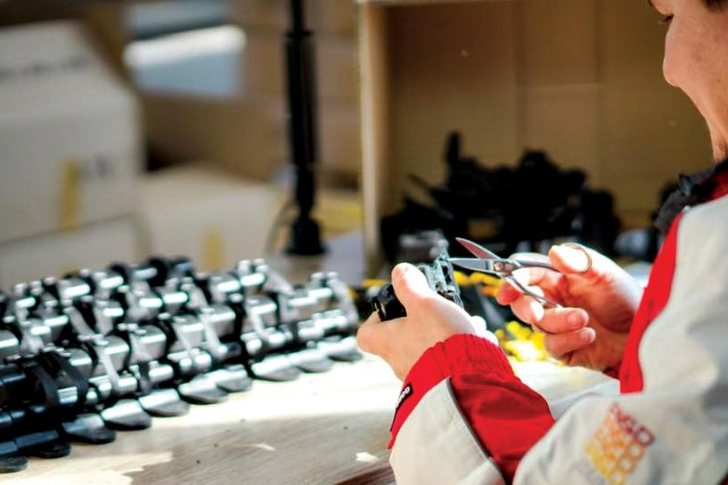
The textile and footwear sector has always been one of the most sensitive sectors to changes in labor costs, exchange rates, as this sector has a labor-intensive nature with a low profit margin.
According to Mr. In fact, the increase in the cost of employee wages, including the minimum wage, has a significant impact on this sector.
He says companies are adapting in several ways to cope with these cost increases, such as automating and modernizing manufacturing plants, focusing on increasing quality and diversifying products.
Some companies are reorganizing their work structure to minimize wage costs.
“This has included optimizing the number of employees, making reductions in positions that are less needed or improving the use of staff in processes that require more work.
In some cases, there are even job cuts to keep costs at affordable levels," he says.
The textile and footwear export sector continues to be in difficulty due to the fall of the euro and ordering contracts from European countries. The sector's difficulties have led to the closure of a number of factories and the reduction of jobs.
Edvin Prençe said that from November 2023 to November 2024, there are more than 10,000 closed jobs and about 50 businesses that have closed their activity in the sector.
There were job cuts in the fashion sector during 2023 as well, where the most affected areas were in Krujë, Fushë-Krujë, Laçi, Lezhë and Shkodër./ Monitor.al

Today, on December 14, 2024, the US dollar is bought at 92...

Calculated for the first time the average prices of the sa...

Today, on December 13, 2024, the US dollar is bought at 92...
After concluding the contract for the first phase of the i...
While the government two years ago entered into a feverish...

Today, on December 12, 2024, the US dollar is bought at 92...

Today, on December 11, 2024, the US dollar is bought at 92...

Pressures for salary increases in the financial sector con...

By the end of 2023, the stock of foreign direct investment...

Today, on December 10, 2024, the US dollar is bought at 92...

For accounting experts, frequent fiscal changes do not all...

Today, on December 9, 2024, the US dollar is bought at 92....

Today, on December 8, 2024, the US dollar is bought at 92....
Last year's balance gave the first signal that perhaps 202...

Are bitcoin fans right to be so excited about Donald Trump...
Today, on December 7, 2024, in the foreign exchange market...

Today, December 6, 2024, in the foreign exchange market, t...

Banks' income from commissions is increasing for the fourt...

Production costs continued to rise in the third quarter, b...

The price of Bitcoin has crossed the $100,000 mark for the...

CNA has launched another investigation that could lead to ...

Irfan Hysenbelliu is a businessman that we call "Irfan the...

In March 2026, CNA launched another investigation centered...
The arrested mayor of Tirana, Erion Veliaj, with 13 charge...

The Special Board of Appeal (KPA) decided this Monday ...

The KPA vetting decided this Thursday to dismiss the p...

Suela Salavaçi, a prosecutor in the Prosecutor's Offic...

The Special Board of Appeal reinstated the prosecutor ...

Footage emerges from the serious accident that occurred th...

A Shkodra traffic police officer was hit with hard objects...

This Wednesday, around 4:00 PM, a serious accident occurre...

Tirana Police have shared details regarding the accident t...

A serious accident that occurred this Wednesday with the c...

The Institute of Geosciences has shared a forecast for wea...

Rising energy and fertilizer prices are expected to contin...

Over 18,000 foreign citizens from 140 countries have appli...

The trial of ousted Venezuelan President Nicolas Maduro on...

US President Donald Trump has issued another warning to Ir...

Prime Minister Andy Burnham has announced that most bus fa...

France's parliament has passed a law to ban social media f...

At a time when industrial products are increasingly taking...

Trust among people is not just a three-syllable word. It c...

Master of humor Todi Llupi has passed away at the age of 7...

The ninth edition of "MIK Festival" kicked off with one of...

The price of diesel reached 206 lek per liter from 198 lek...

Businesses will no longer be required to simply register t...

Despite economic growth and income in recent years, Albani...

This Wednesday, one US dollar is bought for 81.4 lek and s...