


Veliaj's gross mistake/ Concrete mixers "invade" the streets of Tirana
The problem with the circulation of heavy vehicles on the ...

The problem with the circulation of heavy vehicles on the ...

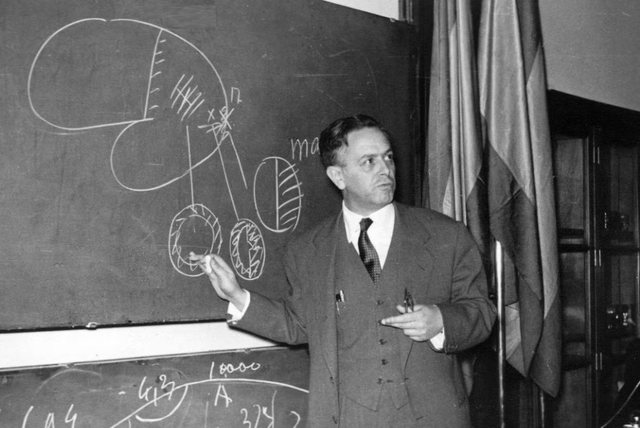
On a spring day in 1938, a 25-year-old man was left lying on the ground. A bullet had pierced his head on the Valencia front during the Spanish Civil War. When mentioned 2 weeks later, the soldier of the republican camp had experienced a shocking change: under certain conditions, he saw the world backwards.
28-year-old doctor Justo Gonzalo followed the patient to a nearby military hospital. The bullet, probably fired by the Francoists, had partially destroyed the ridges in his cerebral cortex in the left parieto-occipital region. The injured survived miraculously, without the need for operations or special care.
Doctor Gonzalo, born in Barcelona in 1910, realized that the unique case - which he called Patient M - could provide a lot of clues about how the human brain works. The Doctor and Patient M survived the war, and continued to meet for nearly half a century, until Justo Gonzalo's death in 1986.
The researcher's daughter Isabel Gonzalo has dug through her father's archives - boxes of hundreds of documents and photos - to rediscover the special case alongside neuropsychologist Alberto García Molina. At a time when the scientific community was divided between those who see the brain as a whole, and those who draw hard boundaries between brain regions, Gonzalo proposed an intermediate hypothesis based on Patient M: the theory of brain dynamics, according to which the body has its functions distributed.
Isabel Gonzalo, who is a physicist and professor at the Complutense University of Madrid, met Patient M during his visits to the family home. The man was born in a village in the Spanish municipality of Ciudad Real. When he rested, he saw distorted images, where objects appeared in 3 copies and green in color.
Even the senses of hearing and touch had undergone changes. Sounds and touches appeared in his mind on the opposite side. "Patient M looked at his watch from every direction to check the time" - remembers Isabel. The details of the case have been published in the magazine "Neurologia".
At the beginning of the 20th century, Spain was at the forefront of human brain studies. The researcher Santiago Ramon i Kajal, had shown in 1888 that the thinking organ was not a widespread mass, as was believed before, but was organized in individual cells called neurons.
Kajal won in 1906 the Nobel Prize in Medicine for his discovery. A school of talented disciples grew up around him, such as neurologist Gonzalo Lafora, who, when the Civil War broke out, recruited Justo Gonzalo to work with him at the Kafka Trauma Center.
There, Gonzalo met Patient M and hundreds of other injured patients. The adaptive capacity of the patients was surprising, as the doctor described in his book "Cerebral Dynamics", published in two volumes between 1945-1950. Patient M "had seen his abnormalities as strange when, for example, he saw men working upside down on a wharf in the harbor," wrote Gonzalo.
"Generally, discomfort goes completely or almost completely unnoticed in the injured. Later, when they find out, they don't seem to care. On the contrary, they consider them as something temporary that does not affect or hinder their daily life" - he further writes.
Patient M also tended to minimize his symptoms: "They are things that only sometimes appear in my vision." Neuropsychologist Alberto Garcia Molina works at the Gatman Institute, a hospital in Barcelona that specializes in the rehabilitation of people with brain damage.
The researcher points out that the history of neurology is full of tragic natural experiments, such as that of Phineas Gage, a railroad captain in the US, who survived an iron rod that pierced his brain on September 13, 1848. The once calm man became very aggressive. and vulgar.
British physician David Ferrier mentioned Gage's case in his 1878 lecture "Localization of Cerebral Disease," in which he pioneered the association of concrete functions with specific areas of the cerebral cortex. Garcia Molina explains that in the 1930s, the modular perspective remained dominant.
"The brain was seen as made up of little boxes. When you change a box, there is a concrete deficit" - explains neuropsychology. For dr. Gonzalon, modular theories could not explain the questions that arose with Patient M, so he began to create his own theory of brain dynamics, breaking away from the dominant view of the time on how the brain works.
The war brought a turning point in Justo Gonzalo's scientific career. He had studied at the University of Vienna in 1934 and at Goethe University in Frankfurt a year later, at the height of Nazism in Germany. After the coup of July 1936 in Spain, he remained loyal to the Republic during the Civil War, and even worked as a doctor in a battalion.
In 1952, the doctor became part of the Cajal Institute in Madrid, where he continued to follow 200 patients with brain injuries, registered in the Corps for the Crippled in the War for the Fatherland, which excluded the wounded who fought on the Republican side.
The letters between Patient M and Gonzalo confirmed that the man who saw the world upside down did not receive a pension as a wounded veteran. "My father admired him, because he was a very smart person, who was able to take care of himself and work in the fields" - remembers Izabel Gonzalo. She says Patient M died in the late 1990s. The identity of the man, who helped better uncover the workings of the human brain, was never revealed./ Adapted from CNA.al


Hilda Bachi has been cooking since last Thursday, breaking...

A YouTuber accused of intentionally crashing his plane to ...

The World Health Organization describes chronic fatigu...

International students in Germany have cited good job pros...

Dublin, London, Amsterdam and Paris are among the most exp...
In June 1965, 6 boys from St. Andrew's College, an Ang...
Some people have a crazy penchant for setting special reco...

If built, the bridge across the Strait of Messina woul...

Shumica e guidave sugjerojnë vende ku mund të udhëtoni me...

Pse njerëzit bëhen spiunë, cilat janë motivet, arsyeti...

Visitors staying at the newly opened Tokyo Haneda Inte...

1. MICRO, San Francisko Shumica e këtyre muzeve të vegjë...

Halfway between Istanbul and Ankara, in one of the mos...

For as long as many can remember, China has been known as ...
The Locust of Gaul was one of the most famous producer...

The Forbes Advisor Travel Bug Index ranks the 25 worst desti...

As the social animals that they are, humans need the c...

Miriam Rodriguez dedicated her life to seeking justice...

A company in France has also entered the "race" of space t...

Cities such as the US and China dominated the top ten, while...

CNA has launched another investigation that could lead to ...

Irfan Hysenbelliu is a businessman that we call "Irfan the...

In March 2026, CNA launched another investigation centered...
The arrested mayor of Tirana, Erion Veliaj, with 13 charge...

The Special Board of Appeal (KPA) decided this Monday ...

The KPA vetting decided this Thursday to dismiss the p...

Suela Salavaçi, a prosecutor in the Prosecutor's Offic...

The Special Board of Appeal reinstated the prosecutor ...

New details have emerged regarding the accident that occur...

New details have emerged from the serious accident that oc...

A serious accident occurred this Wednesday on the Elbasan-...

Citizen MH, 61, a fisherman, was found dead near the islan...

A serious accident that occurred this Wednesday with the c...

The Institute of Geosciences has shared a forecast for wea...

Rising energy and fertilizer prices are expected to contin...

Over 18,000 foreign citizens from 140 countries have appli...

US President Donald Trump has issued another warning to Ir...

Prime Minister Andy Burnham has announced that most bus fa...

France's parliament has passed a law to ban social media f...

US Secretary of State Marco Rubio arrived in Manila on Jul...

At a time when industrial products are increasingly taking...

Trust among people is not just a three-syllable word. It c...

Master of humor Todi Llupi has passed away at the age of 7...

The ninth edition of "MIK Festival" kicked off with one of...

Businesses will no longer be required to simply register t...

Despite economic growth and income in recent years, Albani...

This Wednesday, one US dollar is bought for 81.4 lek and s...

Construction company licenses will have a validity period ...