

Foreign currencies at historic lows/Exchange rate, July 15, 2026
This Wednesday, one US dollar is bought for 81.3 lek and s...


Over the last 35 years, Albania has consistently faced a negative migration balance, as more people have systematically left the country than have returned.
According to the latest Eurostat data from 1990 to 2025, the number of people who left was about 1.8 million higher than the number of people who returned to the country.
For each of the years, Albania has been a country with a net population outflow throughout the period. The country has lost its most precious capital, ranking us at the top of the global list for the deterioration of demographic indicators.
Instead of the phenomenon easing in the fourth decade of transition as has happened in the former Eastern European countries, in our country it has worsened further after the pandemic.
The strongest wave of emigration was recorded during the 1990s. In the period 1990–2001 alone, the negative balance reached about 785.7 thousand people. On average, Albania lost about 65 thousand people per year to migration during this decade. After the fall of the communist regime, emigration was justified due to the isolation during the dictatorship.
The years with the highest departures were 1991, with a negative balance of 123,619 people, then 1995 with -118,022 people, 1997 with -107,503 and 1999 with -105,229 more departures than returns. The massive waves of emigration in the first decade of transition were a consequence of strong changes in the political and economic systems and the conflicts that emerged during the pyramid schemes.
During the years 2002-2013, the pace of departures slowed down, but remained high. During this period, the negative balance reached about 391 thousand more people left than returned, with an annual average of about 33 thousand people. The positive economic cycle and political stability reduced the trend of departures.
But while the phenomenon of emigration was expected to ease based on international practices, during the period 2014-2025 there was a sharp deterioration of the phenomenon, emigration increased as the population base shrank. During this period, the net loss from migration was about 617 thousand people or an average of about 51 thousand per year.
After 2020, emigration marked a sharp deterioration. The negative balance reached 32,853 people in 2021 and 32,497 people in 2022. For the years 2024 and 2025, the net loss is estimated at 28,836 and 28,531 people, respectively, indicating that outflows continue to be significantly higher than inflows. The year 2023 results in a high net migration stock of around -373 thousand people as a result of statistical corrections to the 2023 census.
Net migration has returned to high levels in recent years, deepening Albania's population contraction. After a temporary slowdown during the second half of the last decade, the negative migration balance has widened again after the pandemic, with around 29-33 thousand more people leaving the country than entering each year.
Data shows that emigration has been one of the main factors in Albania's population decline over the past three and a half decades. Although emigration is no longer at the scale of the 1990s, the country continues to lose around 28,000-30,000 net residents each year, a pace that is accelerating population aging, shrinking the labor force, and narrowing the base of contributors to social schemes./ Monitor

This Wednesday, one US dollar is bought for 81.3 lek and s...

The number of foreign exchange offices declined in 2025, f...
In addition to the effect on the decline in demand for rea...
This Tuesday, one US dollar is bought for 81.5 lek and sol...

The tax administration has announced the completion of the...
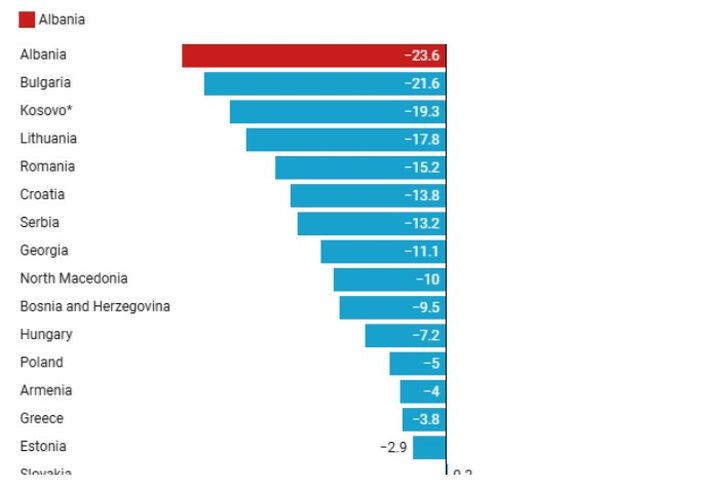
Albania has lost almost a quarter of its population since ...
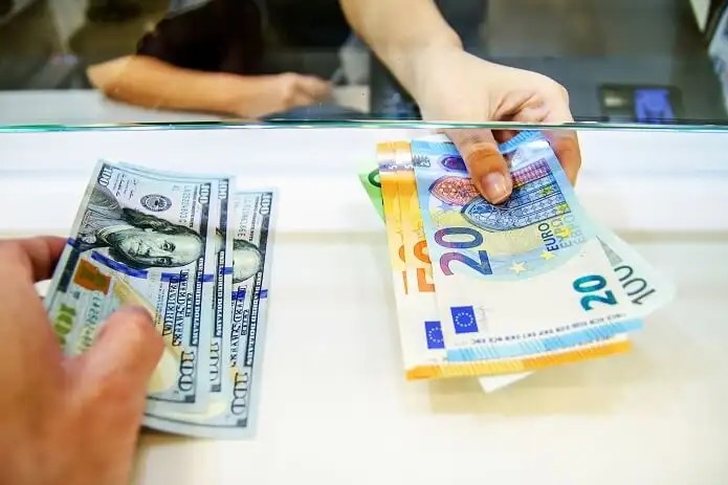
This Monday, one US dollar is bought for 81.5 lek and sold...

This Sunday, one US dollar is bought for 81.5 lek and sold...

The new old-age pensions in 2025 were on average 16,500 le...

This Saturday, one US dollar is bought for 81.4 lek and so...

The escalation of the conflict in the Middle East has once...

In addition to food, household appliances, oil, and more, ...
The government has reduced the funds foreseen for rural de...

This Friday, one US dollar is bought for 81.4 lek and sold...

The Tax Directorate has announced that the process of auto...
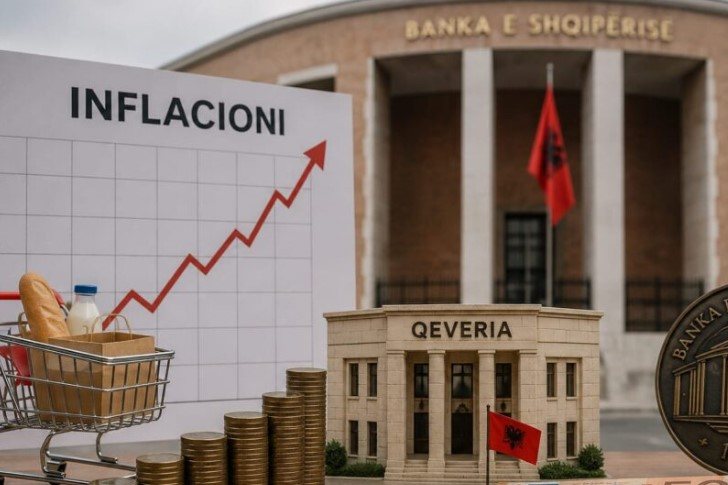
If coordinated policies are not undertaken by the Bank of ...

In the 2026 budget revisions, the Ministry of Defense budg...
Although about 6 months have passed since the start of the...
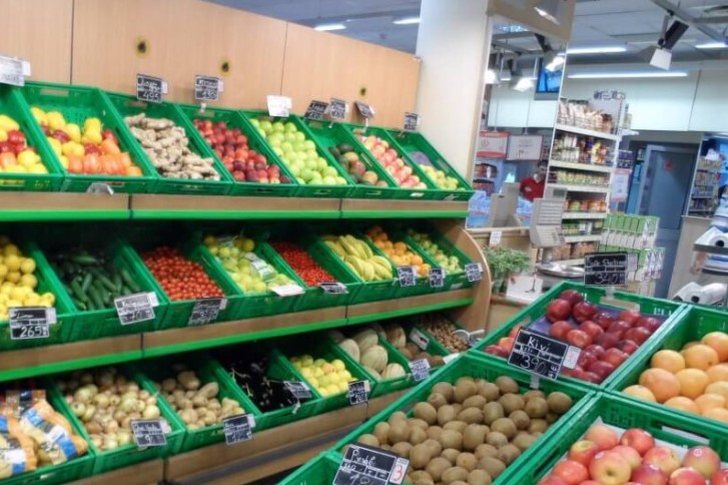
Vegetable prices marked a strong increase in June, precise...
This Thursday, one US dollar is bought for 81.5 lek and so...

Qytetarët që kalojnë pasditen pranë Liqenit Artificial në ...

On the morning of July 7, 2026, the Ministry of Culture ur...
After the disclosure of the portfolio of properties an...

For 6 months now, CNA has been sending several letters to ...

The Special Board of Appeal (KPA) decided this Monday ...

The KPA vetting decided this Thursday to dismiss the p...

Suela Salavaçi, a prosecutor in the Prosecutor's Offic...

The Special Board of Appeal reinstated the prosecutor ...

An accident occurred this evening in the village of Vranis...
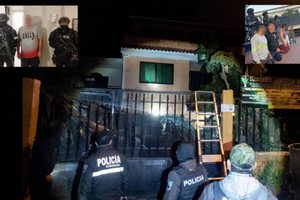
An operation carried out by the National Police and the P...
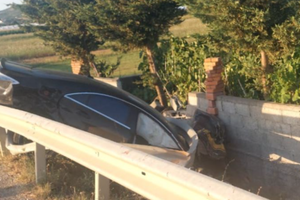
The police have issued an official response regarding the ...

A serious accident has reportedly occurred on the Cërrik-M...
Today, our country will remain under the influence of stab...

The latest report compiled by the European Transport Safet...

The Albanian woman is on average 2 years older than the Al...

The number of theft-related crimes has increased following...

The British government has announced plans to impose night...
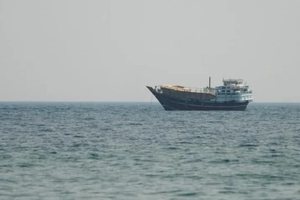
US President Donald Trump has warned Iran of new attacks o...
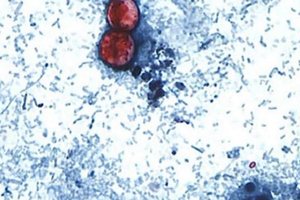
An outbreak of the parasitic infection Cyclosporiasis has ...
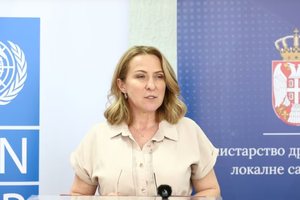
Kosovo has declared Serbian Minister Snezhana Paunovic an ...

Master of humor Todi Llupi has passed away at the age of 7...

The ninth edition of "MIK Festival" kicked off with one of...

A historic evening for Albanian culture was marked in the ...

When I turned 10, another building was built in front of o...
Albania, along with other Western Balkan countries, risks ...
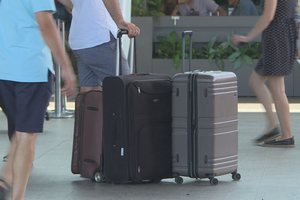
Over the last 35 years, Albania has consistently faced a n...

This Wednesday, one US dollar is bought for 81.3 lek and s...

The number of foreign exchange offices declined in 2025, f...