


Second victim of bad weather/ Fisherman drowns in Ksamil
Citizen MH, 61, a fisherman, was found dead near the islan...

Citizen MH, 61, a fisherman, was found dead near the islan...

In the first quarter of 2024, the average exchange rate of the euro with the lek reached 103.8 lek, the lowest historical level.
Compared to the same period a year ago, when the euro was exchanged at an average of 115 lek, the common currency has depreciated by 9.7%.
The fall of the euro theoretically means that more currency has officially entered the country and less has left, thereby increasing the supply of the common currency. The sources of currency inflow into the country are exports, foreign tourists' expenses, emigrants' inflows, income from services, etc.
While the biggest expenditure is for the purchase of imported goods, on which we are becoming more and more dependent, as a result of the difficulties that domestic production is going through.
But, the official data in the first quarter of the balance of payments, which measures the transactions of currency entering and exiting the country, showed that the official figures do not explain the strengthening of the lek.
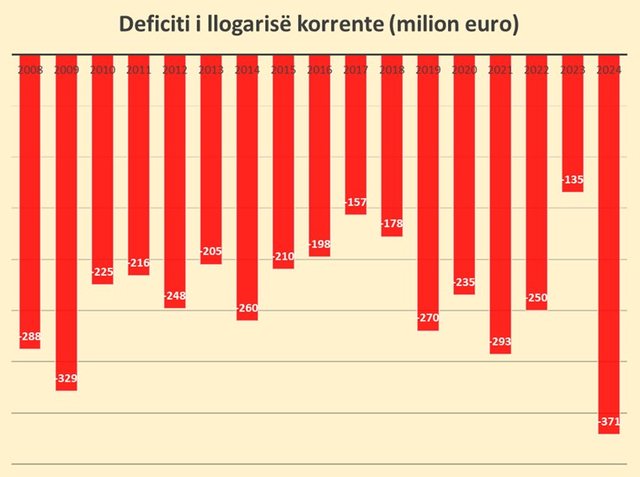
The current account deficit experienced a strong increase for the first quarter of 2024 and reached the highest level ever recorded for this period of the year.
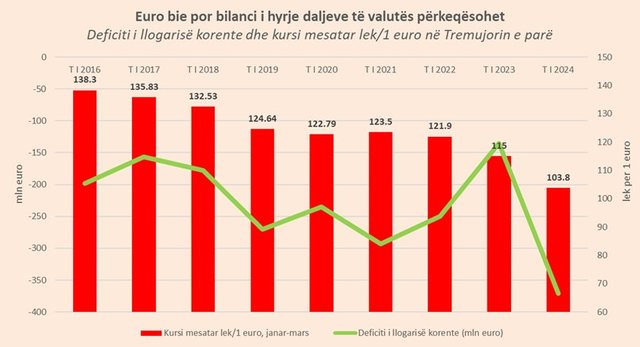
Bank of Albania statistics show that the current account deficit reached the value of -371 million euros, an increase of 190% compared to the same period last year. In the same period a year ago, the deficit was -135 million euros, almost half of the previous year.
Theoretically, a worsening of the current account deficit should affect the depreciation of the local currency and vice versa. In 2024, the opposite happened. The lek has strengthened while the current account deficit has worsened.
The performance of the current account deficit and the exchange rate ( see the chart: Current account deficit and average lek/1 euro exchange rate in the first quarter ) explains the strengthening of the lek only in the period 2022-2023, when the current account deficit showed signs of improvement.
The current account balance has undergone a rapid reversal compared to last year, when the deficit reached the lowest historical level, even in the third quarter of the year this balance turned out to be positive.
The increase in the deficit is mainly due to the deepening of the trade deficit in goods, which this time could not be sufficiently balanced by the positive balance of services and secondary income.
For the first quarter, the trade deficit in goods reached a record value of 1.24 billion euros, increasing by 39% compared to last year. While imports increased by 18%, exports of goods decreased by 20%.
The trade balance in services continued to improve, but to a small extent. The surplus in the services account reached 629 million euros, increasing by 11.5% compared to the first quarter of last year.
The main contribution to the services account was again provided by tourism, which brought net income in the amount of 267 million euros, an increase of 41% compared to the first quarter of last year.
However, the high growth rates of tourism income have not been enough to close the big "hole" in the trade of goods. This is also due to the fact that other items of the services account, such as fashion or other services, suffered a decrease in income compared to a year ago.
In particular, revenues from services for processing physical inputs owned by others (fabrication) experienced a 3% decrease in revenues compared to the first quarter of last year.
The item of secondary income, which consists mainly of remittances from immigrants, also had a positive effect in the first quarter. The value of remittances during the first quarter reached 242 million euros, increasing by 13% compared to a year ago.
Although the current account deficit has widened significantly, the financial account and especially foreign direct investments continue to bring significant flows, which even in the first quarter compensated most of the current account deficit. Foreign direct investments had a value of 354 million euros, as much as 95% of the value of the current account deficit./ Monitor.al

Today, on June 11, 2024, in the foreign exchange marke...
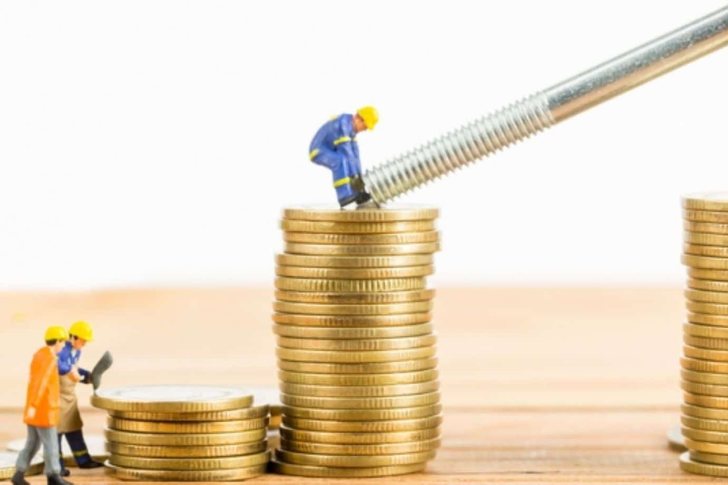
Foreign direct investments have started with growth this y...
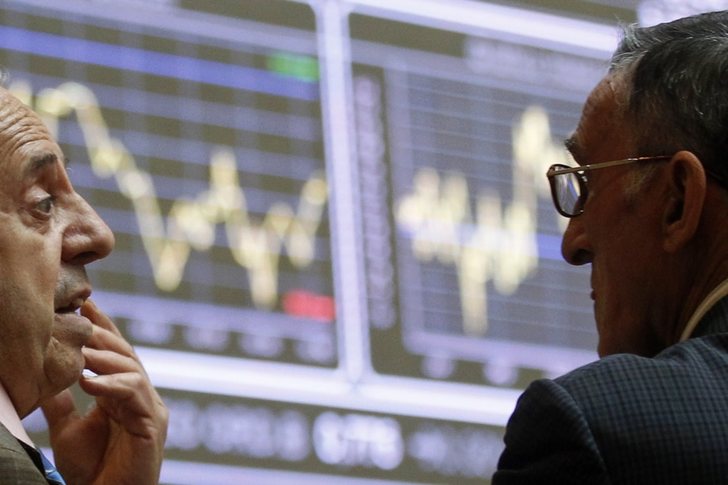
The European Parliament elections were followed by the wea...

Today, on June 10, 2024, in the foreign exchange marke...

The price of houses has become unaffordable for the ma...

Today, on June 9, 2024, in the foreign exchange market, th...
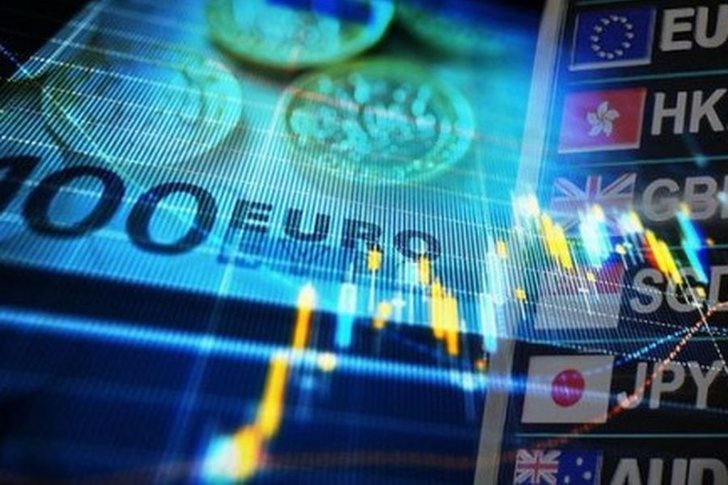
Today, on June 8, 2024, in the foreign exchange market...

Every year fewer and fewer new businesses are created....
Today, on June 7, 2024, in the foreign exchange market...
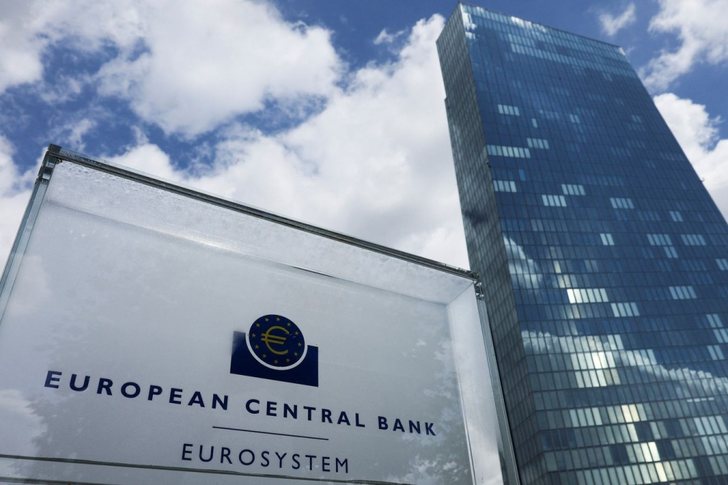
The European Central Bank (ECB) has cut interest rates for...

The Health System Improvement Project supported by the...

The economy of the country is increasing year after year t...
Today, June 6, 2024, in the foreign exchange market, t...
Compared to the first quarter of 2023, the import price in...
Chromium continues to be the mineral with the greatest...

The lack of labor, influenced by demographic movements and...

Today, on June 5, 2024, in the foreign exchange market...
Oil prices fell more than $1, extending losses from a ...

From the month of June, livestock farmers of small far...

Today, June 4, 2024, in the foreign exchange market, t...

CNA has launched another investigation that could lead to ...

Irfan Hysenbelliu is a businessman that we call "Irfan the...

In March 2026, CNA launched another investigation centered...
The arrested mayor of Tirana, Erion Veliaj, with 13 charge...

The Special Board of Appeal (KPA) decided this Monday ...

The KPA vetting decided this Thursday to dismiss the p...

Suela Salavaçi, a prosecutor in the Prosecutor's Offic...

The Special Board of Appeal reinstated the prosecutor ...
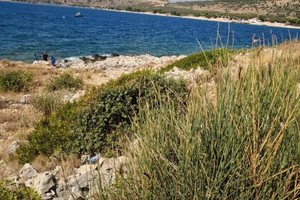
Citizen MH, 61, a fisherman, was found dead near the islan...

Another phase of the international operation, codenamed "T...

Police have arrested a 34-year-old woman at Rinas Airport ...

A serious accident has occurred on the Lezhë-Shëngjin axis...

This Wednesday, our country will be under the influence of...

All of Southern Europe will face changing weather conditio...

Albania was hit by temperatures significantly higher than ...

For the first time, Pogradec welcomed the Inter-Lake Chess...

Prime Minister Andy Burnham has announced that most bus fa...

France's parliament has passed a law to ban social media f...

US Secretary of State Marco Rubio arrived in Manila on Jul...

In the space of a few days, Ukrainian President Volodymyr ...

At a time when industrial products are increasingly taking...

Trust among people is not just a three-syllable word. It c...

Master of humor Todi Llupi has passed away at the age of 7...

The ninth edition of "MIK Festival" kicked off with one of...

Businesses will no longer be required to simply register t...

Despite economic growth and income in recent years, Albani...

This Wednesday, one US dollar is bought for 81.4 lek and s...

Construction company licenses will have a validity period ...